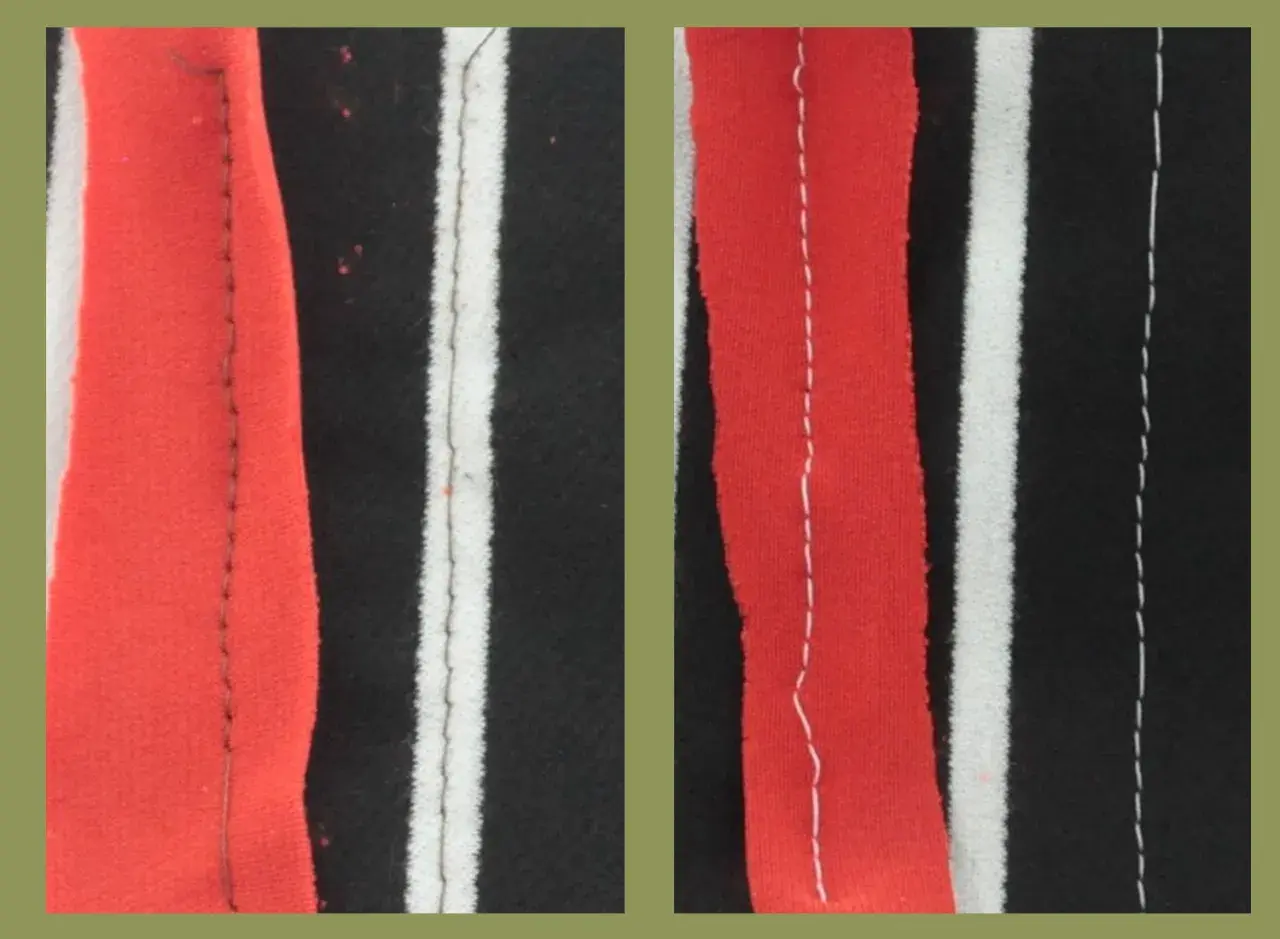
The quickest way to choose the right needle
- Use a ballpoint or jersey needle for everyday knits such as cotton jersey, interlock, rib knit, and many T-shirt fabrics.
- Use a stretch needle for highly elastic fabrics, especially knits with elastane, activewear, swimwear, and synthetic stretch materials.
- In the UK, ballpoint needles are often sold as jersey needles, while stretch needles are usually labelled separately.
- Needle size matters almost as much as needle type: lighter knits usually want smaller sizes, heavier knits want larger ones.
- If stitches still skip, check the stitch type, thread, tension, and presser-foot pressure before assuming the needle is the only problem.
How the two needles differ in real sewing
Both needles are made for knit fabrics, and both use a rounded point rather than a sharp one. That said, they are not identical. A ballpoint needle has a rounded tip that slips between the knit loops, which helps prevent broken fibres and keeps the fabric from being pierced like a woven cloth. A stretch needle goes a step further: it is built for fabrics with more rebound, and its special eye and scarf help the machine form stitches more reliably on very elastic material. That extra engineering is the part people often miss. The scarf is the small indentation above the eye that helps the hook pick up the thread cleanly, and the eye design can reduce skipped stitches when the fabric is moving a lot under the needle. I think of ballpoint as the general-purpose knit needle and stretch as the problem-solver for stubborn stretch fabrics.| Feature | Ballpoint needle | Stretch needle | What it means in practice |
|---|---|---|---|
| Tip | Rounded | Rounded | Both avoid cutting knit fibres, but the stretch needle is tuned for more movement. |
| Extra design | Standard eye and scarf | Special eye and scarf | The stretch needle is better at reducing skipped stitches on highly elastic fabrics. |
| Typical use | Knits and some stretch fabrics | Elastic materials and highly elastic knitwear | Ballpoint is the safer everyday choice; stretch is the specialist. |
| Common sizes | 70/10, 80/12, 90/14, 100/16 | 65/9, 75/11, 90/14 | Smaller sizes suit lighter fabrics, larger sizes suit thicker or denser seams. |
| Typical result | Clean seams on stable knits | Better stitch formation on high-stretch fabrics | Choose based on how much the fabric stretches, not just how it looks. |
If I had to reduce it to one line, I would say this: ballpoint handles most knit sewing well, while stretch needles are worth reaching for when the fabric is more elastic than the average jersey. That difference sounds small, but it is usually what separates an acceptable seam from one that keeps skipping or bubbling.
When a ballpoint needle is enough
For many sewing projects, a ballpoint needle is the one I reach for first. It works well on fabrics that stretch a little but still behave predictably under the presser foot. That includes cotton jersey, interlock, rib knit, many sweatshirt fabrics, and lighter French terry. In UK haberdashery, this needle is often sold as a jersey needle, which is the same basic idea under a different name.
The reason it works is simple: the rounded tip parts the knit loops instead of spearing through them. That keeps the fabric from getting tiny runs, makes holes less obvious, and usually gives you a neater seam on T-shirts, children's clothes, sleepwear, and casual tops. If the fabric feels stable and the machine is already producing clean stitches, I would not complicate things by jumping straight to a stretch needle.
- Cotton jersey and interlock usually sew cleanly with a ballpoint needle.
- Rib knit for cuffs and neckbands often responds well to ballpoint, especially on moderate stretch.
- French terry and sweatshirting can work well with ballpoint when the fabric is not extremely elastic.
- Everyday casual garments are often the place where ballpoint saves time and produces the least fuss.
My rule here is practical: if the fabric stretches, but it snaps back calmly and does not fight the stitch, ballpoint is usually enough. From there, I only move to a stretch needle if the seam starts telling me it wants one.
When a stretch needle earns its place
A stretch needle becomes more valuable as the fabric’s elasticity increases. I reach for it on activewear, swimwear, leggings, performance knits, and synthetic fabrics with a lot of recovery. It is also the needle I would test on highly elastic synthetic knitwear and synthetic suede, because the special eye and scarf are built to reduce skipped stitches when the fabric is moving aggressively under the needle.
This is the part of the comparison that matters most: a ballpoint needle can be perfectly fine on many knits, but once the fabric contains a high amount of elastane or behaves almost like a spring, the stretch needle often creates a cleaner stitch path. The machine hook has an easier job catching the thread, and the seam is less likely to come out with missing links or little gaps. If I am sewing something that needs strong recovery after wear, I prefer to start with stretch rather than waste time chasing skipped stitches later.
- Activewear and leggings benefit from the stretch needle because the seam has to move with the fabric.
- Swimwear and dancewear often need the extra stitch stability that a stretch needle provides.
- Viscose jersey with elastane can be tricky enough that stretch needles are the more reliable first choice.
- Highly elastic synthetic knits are exactly where the extra design of the needle starts to matter.
I still would not call it magic. If the stitch type is wrong, the tension is off, or the needle is old, a stretch needle will not rescue the seam on its own. But when the fabric itself is the problem, this is the needle that usually gives me the best first result.
How I match size and thread to the fabric
Needle type solves one part of the puzzle; size solves the other. A needle that is too large can leave visible holes or make the seam feel heavy, while one that is too small may bend, skip, or struggle with thicker threads and layered seams. When I am choosing between ballpoint and stretch needles, I also look at fabric weight, seam thickness, and thread choice.
| Fabric behaviour | Good starting point | Why I would begin there |
|---|---|---|
| Light jersey with moderate stretch | 70/10 ballpoint or 65/9 stretch | Smaller sizes keep the stitch neat and avoid oversized holes. |
| Standard T-shirt knits and ribbing | 75/11 ballpoint or 75/11 stretch | This is the range I use most often for everyday knit sewing. |
| Heavier jersey, ponte, or thicker knit seams | 80/12 or 90/14 | A slightly stronger needle handles density better without forcing the fabric. |
| Very elastic, high-recovery fabrics | Stretch needle first | The special eye and scarf help when the fabric keeps moving away from the hook. |
As a practical habit, I match the needle to the thread as well. A fine thread pairs better with lighter fabric and a smaller needle, while thicker thread usually needs a larger needle and a fabric that can tolerate it. If the seam looks puckered, the first question I ask is not “which needle is fashionable here?” but “is the needle size actually balanced against the cloth and thread?”
Where neither needle is the right answer
There is one easy trap in this topic: assuming that every fabric with some stretch belongs in the same category. It does not. If the fabric is woven and has little to no stretch, neither a ballpoint nor a stretch needle is the best fit. That is where a universal, microtex, or a fabric-specific needle family makes more sense. Knits and wovens behave differently at the stitch level, and the needle should respect that.
The other trap is blaming the needle for every stitch problem. Skipped stitches can come from a dull needle, an incorrectly threaded machine, the wrong stitch length, poor thread quality, or too much presser-foot pressure. A seam that waves or tunnels may be a tension or feed problem rather than a needle problem. I usually test in this order:
- Change the needle if it is old, bent, or unknown.
- Test the same seam on a scrap of the same fabric.
- Switch from ballpoint to stretch if the fabric is very elastic or the seam still skips.
- Adjust the stitch type and machine settings only after the needle choice is confirmed.
That sequence saves time. It also stops you from changing three variables at once and never knowing which one actually fixed the seam.
The simple rule I use before I sew the final seam
My personal rule is uncomplicated: start with ballpoint for ordinary knits, and move to stretch when the fabric is highly elastic, synthetic, or stubborn about forming a clean stitch. If the seam looks tidy on the scrap, stretches with the fabric, and does not leave damaged loops behind, I keep going. If it skips, I do not fight the machine with guesswork; I change the needle family and test again.
- Use ballpoint when the knit feels stable and everyday.
- Use stretch when the fabric has strong recovery or a lot of elastane.
- Use the right size for the fabric weight, not just the fabric type.
- Always test on offcuts before committing to the garment.
That approach is usually enough to decide the issue quickly and avoid the most common sewing-machine frustrations. Once you treat the needle as part of the stitch system rather than a random consumable, knit sewing becomes much more predictable.