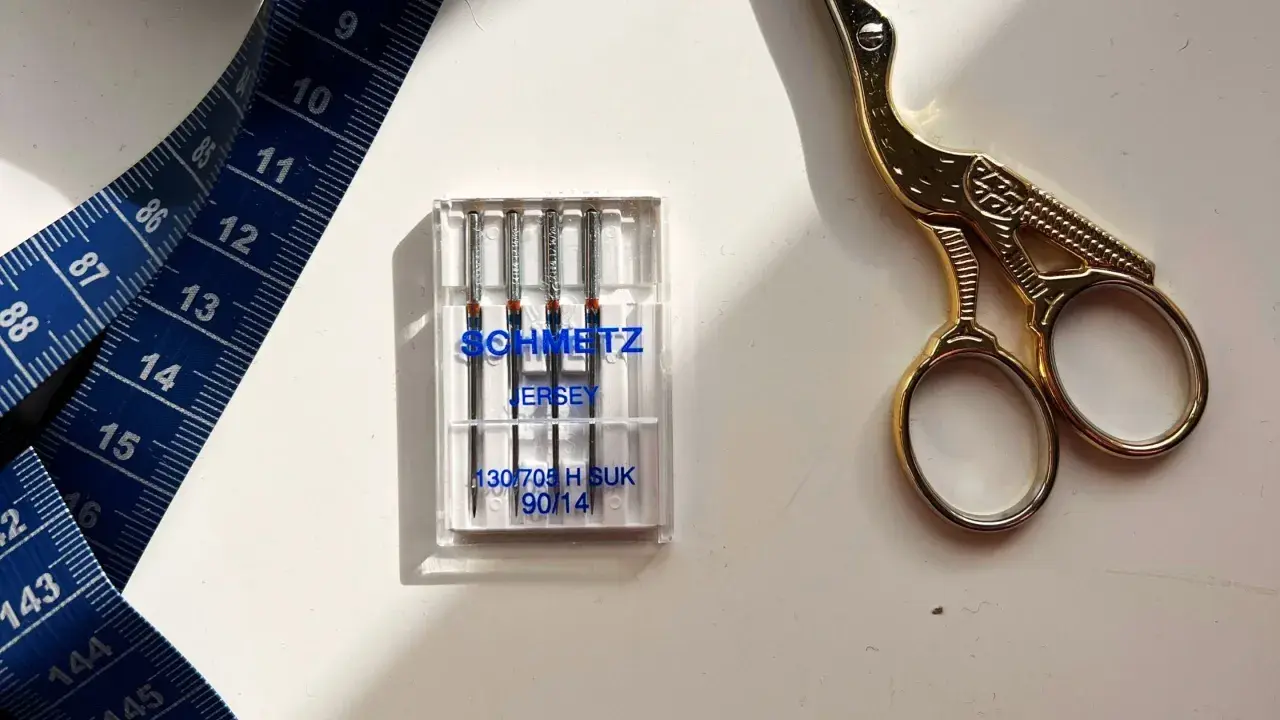
A stretch needle in 75/11 or 80/12 solves most knit sewing
- 75/11 and 80/12 are the safest everyday starting sizes for most jersey and knit projects.
- 70/10 suits fine, lightweight knits, while 90/14 is better for thicker seams and heavier knitwear.
- Use a stretch needle for highly elastic fabrics with Lycra, Spandex, or strong recovery.
- Use a ballpoint or jersey needle for standard knits when you do not need a specialised stretch point.
- In the UK, packets usually show both size systems, so 75/11 is the same size in metric and imperial notation.
- A fresh needle matters as much as the right size; a dull needle can cause skipping, shredding, and weak seams.
How I match the needle size to the fabric weight
I start by looking at how the fabric behaves in my hands. A soft T-shirt jersey does not need the same needle as a dense ponte, and a fabric with a lot of elastane needs more help than a stable cotton knit. As a rule, I move smaller for fine fabrics and larger for heavier ones, because the needle has to pass through the material cleanly without punching oversized holes or deflecting in the seam.
For most garments, this is the range I use first:
| Fabric or project | Best starting size | Needle type | Why I start there |
|---|---|---|---|
| Very fine jersey, tricot, lightweight rib | 65/9 or 70/10 | Stretch or jersey | Reduces visible holes and keeps the seam looking clean on delicate knits. |
| Everyday T-shirt jersey and interlock | 75/11 or 80/12 | Jersey or stretch | This is the most forgiving middle ground for general knit sewing. |
| Leggings, swimwear, activewear, high-spandex knits | 75/11 | Stretch | The fabric rebounds hard, so I want a needle designed to reduce skipped stitches. |
| Sweatshirting, ponte, double knit | 90/14 | Stretch or jersey | Heavier knits and seam layers need more shaft strength and a slightly larger eye. |
| Bulky seams or multiple layers at hems and necklines | 90/14 | Stretch | It handles more resistance, but I still test before going larger. |
I rarely begin above 90/14 for stretch sewing. Bigger is not automatically better; if the needle is too large, it can leave visible holes or make a soft knit look battered before the garment is even finished. On the other hand, a needle that is too fine for the thread or the seam thickness can shred thread, bend, or start skipping stitches.
If I only had one practical takeaway here, it would be this: 75/11 and 80/12 solve most stretch-fabric jobs, and 90/14 is the useful step up when the fabric gets thicker. Once that size logic is clear, the next question is which needle type actually belongs in the machine.
Jersey, stretch and ballpoint needles are not interchangeable in every situation
Needle size matters, but needle type matters just as much. A ballpoint or jersey needle has a rounded tip that slips between the loops of knit fabric instead of cutting through them. A stretch needle does the same basic job, but its eye and scarf are designed more aggressively to reduce skipped stitches on highly elastic fabrics.
The scarf is the small recessed area above the eye that helps the hook catch the thread loop. When that detail is right, the machine forms stitches more reliably. That is why a stretch needle often behaves better on fabrics with strong recovery, especially when the seam is under tension.
| Needle type | Best for | What I use it for |
|---|---|---|
| Ballpoint / jersey | Standard knits, T-shirt jerseys, interlock, many sweater knits | My default choice when the fabric is stretchy but not overly technical. |
| Stretch | Highly elastic knits, Lycra, Spandex, elastic-rich fabrics, sportswear | The better choice when seams skip, bounce, or need more stitch security. |
| Universal | Only the most stable knits, and mostly as a test option | I do not rely on it for difficult stretch fabrics because it is not built for the job. |
In practice, I treat jersey needles as the general-purpose option and stretch needles as the specialist option. If the fabric contains a noticeable amount of elastane and the seam has to move with the body, I reach for stretch first. If I am sewing a basic cotton jersey T-shirt, jersey or ballpoint is usually enough.
There is also a useful limit here: a universal needle can seem fine on a test strip and then fail once the seam is under real wear. That is why I do not judge a needle by the first few centimetres alone; I judge it by how the finished seam behaves when it is stretched. Next, I focus on the machine settings that either support the needle or sabotage it.
Machine settings that let the needle do its job
The right needle will not rescue a badly set-up machine. On stretchy fabrics, I always check three things before I sew the actual garment: the needle is fresh and inserted correctly, the thread is suitable for the fabric, and the stitch will move with the knit instead of fighting it.
- Use a fresh needle. I replace one after roughly 8 to 10 hours of stitching, or sooner if I hit a pin or hear a dull thud. A tired needle is a common cause of skipped stitches.
- Match thread and needle size. If the thread is thick for the eye, it can shred. If the thread is very fine and the needle is too large, the seam can look rough.
- Choose the right stitch. A straight stitch does not stretch. For seams that need give, I use a stretch stitch, a narrow zigzag, or the machine’s knit stitch setting if it has one.
- Keep stitch length sensible. For many knit seams, I stay around 2.5 to 3.0 mm. That is not a fixed rule, but it is a reliable starting range.
- Let the feed dogs move the fabric. If I push or pull the cloth, I increase needle deflection and make breakage more likely.
- Reduce presser foot pressure if needed. Softer jerseys can stretch before the needle even lands if the foot presses too hard.
One thing I see often is this: someone chooses the right needle size, then sews the seam with the wrong stitch and assumes the needle failed. In reality, the needle was only half the solution. The machine has to let the seam flex, or the fabric will either pop the stitches or wave after pressing. That brings us to the signs that the needle is not the right match.
What the wrong size looks like at the machine
When a stretch seam misbehaves, the fabric usually tells you the problem quickly. The challenge is reading the symptom correctly. I try to identify whether the issue is the size, the type, the age of the needle, or a machine setting that is too aggressive for the fabric.
| What I see | Likely cause | First fix I try |
|---|---|---|
| Skipped stitches | Wrong needle type, needle too dull, or needle not suited to a very elastic knit | Switch from universal to stretch, or move from jersey to stretch if the fabric is highly elastic. |
| Visible holes in the seam | Needle is too large for the fabric | Step down from 90/14 to 80/12, or from 80/12 to 75/11. |
| Thread shredding or breaking | Needle eye too small, needle damaged, or thread too heavy | Replace the needle and check whether the thread needs a larger eye or a finer weight. |
| Wavy seam or tunnelled stitching | Tension or foot pressure too high, sometimes combined with the wrong needle size | Ease the tension slightly and reduce presser foot pressure before changing the needle again. |
| Seam pops when stretched | Stitch choice does not allow movement, even if the needle size is correct | Use a stretch stitch or narrow zigzag and retest on scrap. |
When I troubleshoot, I change one thing at a time. That matters. If I swap the needle, the stitch, and the tension at once, I never know which change actually fixed the problem. A calm test on a scrap is far more useful than guessing on the garment itself.
If the seam still skips after I have moved into the right size range, I stop blaming the size alone. At that point the needle type, thread choice, or machine timing may be the real issue. That small shift in thinking saves a lot of frustration, which is why I always finish with one simple rule.
The starter rule I use before sewing a new stretch fabric
If I am standing in front of a fabric I have not sewn before, I start with 80/12 for a medium jersey, move down to 75/11 for lighter knits, and move up to 90/14 for thicker seams or denser knitwear. If the fabric has a lot of elastane or behaves like activewear, I choose a stretch needle before I do anything else. That sequence covers most projects without overcomplicating the decision.
The real habit that pays off is testing. A scrap tells me more than a package label ever will, especially when the knit is unusual, the seam has several layers, or the thread is heavier than expected. Keep the right sizes in your sewing box, replace them before they go dull, and let the fabric, not guesswork, decide whether you stay at 75/11, move to 80/12, or need the extra security of 90/14.