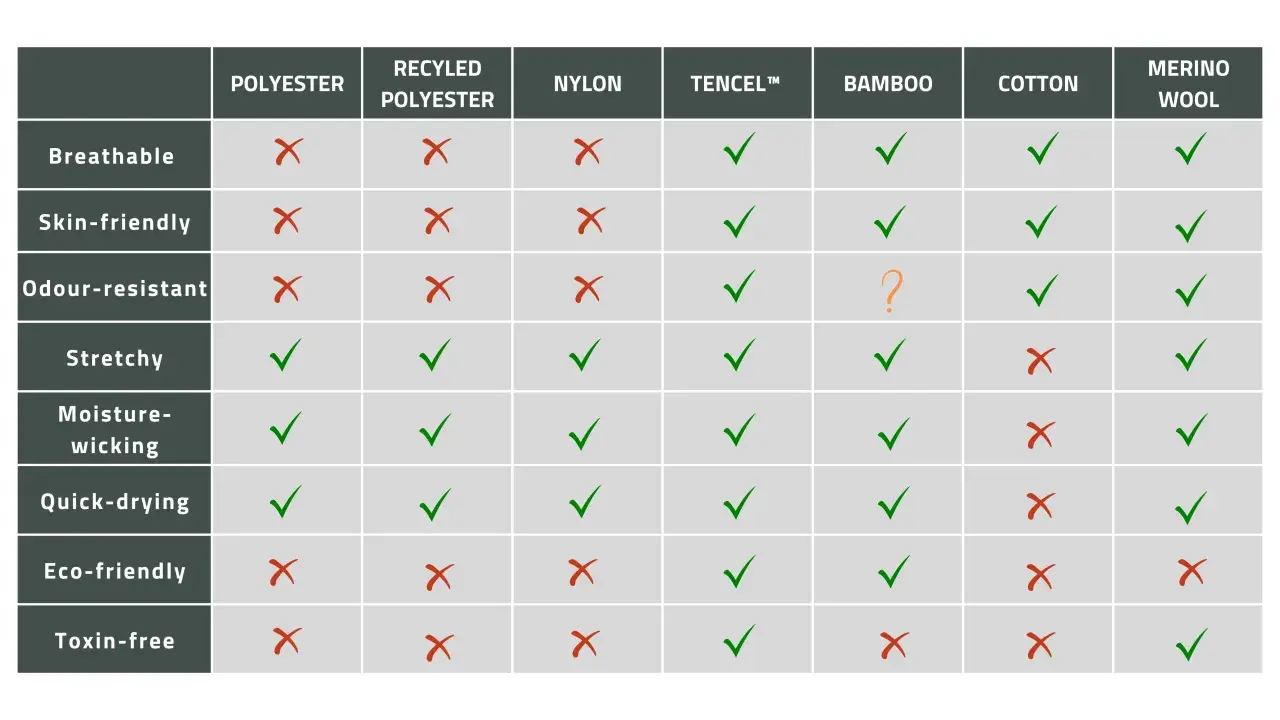
A good sportswear fabric has to do four jobs at once: move sweat, stretch without going baggy, hold its shape, and survive frequent washing. In this guide I break down the fibres, knit structures, and buying checks I use when I want activewear that performs in real life, not just on a swatch card. If you are choosing cloth for a sewing project or comparing finished garments, the useful questions are the same: what happens under heat, movement, and friction?
What matters most when choosing performance fabric
- Moisture handling matters more than softness alone; sweat needs to move away from the skin and dry quickly.
- Stretch recovery is non-negotiable for leggings, fitted tops, and any garment that gets repeated strain.
- Knit structure changes the feel as much as fibre content does, especially for breathability and opacity.
- Polyester and nylon do most of the heavy lifting in training wear, with elastane added for recovery.
- Merino blends are excellent for base layers and cooler conditions, but they are not the cheapest or most abrasion-resistant option.
- Quality checks like recovery, pilling, and opacity tell you more than a smooth hand feel ever will.
What a good performance fabric actually has to do
When I evaluate activewear cloth, I start with four jobs: moisture transport, stretch recovery, breathability, and abrasion resistance. Moisture transport means sweat moves away from the skin instead of sitting there; stretch recovery means the fabric returns to shape after a squat, run, or repeated wash; breathability is about heat escape; abrasion resistance keeps the inside of thighs, straps, and seat areas from wearing out too early.Weight helps, but it is not the whole story. In practice, airy training tops often sit around 120-180 gsm, while leggings and sculpting pieces are commonly denser, around 180-280 gsm. I would not treat those numbers as rules, though. A well-built 170 gsm knit can outperform a badly made 220 gsm one if the yarns, structure, and finish are better.
| Property | Why it matters | What I look for |
|---|---|---|
| Moisture management | Reduces clamminess, chafing, and that cold-after-sweat feeling | Fast dry time, wicking behaviour, good one-way transfer |
| Stretch recovery | Prevents knees, seats, and elbows from bagging out | Elastic return that looks clean after repeated extension |
| Breathability | Lets heat escape during high output or warm-weather training | Open knit zones, mesh panels, lighter yarns |
| Durability | Keeps the garment wearable after repeated friction and washing | Tight enough construction, low pilling, stable seams |
Once those basics are clear, fibre choice becomes much easier, because each material solves a different part of the problem.
The fibre choices that actually work in training clothes
Most activewear is a blend, not a single fibre. That is deliberate. A base fibre provides the main feel and durability, while elastane adds recovery, and sometimes a second fibre adjusts softness or temperature control. For fitted garments, I usually expect elastane to sit in the blend rather than dominate it; roughly 5-15% is a common comfort-first range, while more compressive pieces often go higher.
| Fibre | Strengths | Limits | Best use |
|---|---|---|---|
| Polyester | Quick drying, stable, good value, easy to print | Can hold odour if the finish is poor; feels less plush than nylon | Running tops, teamwear, base training layers |
| Nylon / polyamide | Soft hand feel, strong abrasion resistance, good stretch feel | Usually more expensive than polyester | Leggings, cycling shorts, premium sports bras |
| Elastane | Stretch and recovery; keeps garments close to the body | Not used alone; can weaken with heat, age, and overuse | Blended into almost all fitted activewear |
| Merino wool | Natural temperature regulation, odour resistance, comfort | More costly; less abrasion-tough than synthetics | Base layers, hiking tops, cooler-weather training |
| Cotton | Soft, familiar, breathable at rest | Absorbs sweat and dries slowly | Low-sweat lifting, lounge pieces, recovery wear |
| Recycled polyester | Performance close to conventional polyester when well made | Quality varies; microfibre release still matters | General activewear, kits built with a lower-impact brief |
I treat nylon as the premium all-rounder for leggings and body-hugging pieces, polyester as the workhorse for quick-dry tops, and merino as the specialist for temperature swings and odour control. Cotton has a place, but I would not choose it for a high-sweat interval session unless comfort at rest matters more than dry time. That distinction matters more than branding, and it leads straight into how the fabric is built.
How knit structure changes breathability, stretch and support
Two fabrics can share the same fibre blend and feel completely different if the knit is different. A looser or more open structure usually breathes better; a tighter knit supports better and shows less. That is why a jersey tee, an interlock legging, and a mesh panel all behave differently even when they are all polyester-based.| Structure | What it feels like | Where it works best |
|---|---|---|
| Single jersey | Light, flexible, drapey, often the most breathable | Tops, base layers, summer training wear |
| Interlock | Denser, smoother, more stable, usually better opacity | Leggings, fitted tees, sculpting garments |
| Rib knit | Highly elastic across the width, close-fitting, responsive | Cuffs, panels, fitted side sections |
| Mesh | Very open, lightweight, fast to vent heat | Underarm zones, back panels, ventilation inserts |
| Brushed back knit | Soft on the skin, slightly warmer, less airy | Cool-weather layers, warming pieces, recovery wear |
If I want opacity in leggings, I usually start with an interlock or another dense knit rather than an airy single jersey. If I want a tee that disappears on the body during a run, I look for a lighter jersey with smart ventilation. The fibre gets the attention, but the knit often decides the experience.
How I match the fabric to the workout
For UK conditions, this matching step matters even more than it does on paper. Damp weather, indoor-to-outdoor transitions, and short bursts of effort followed by cool-down all punish the wrong cloth quickly. I want the fabric to suit the movement pattern, not just the silhouette.
| Activity | Main priorities | What I would choose |
|---|---|---|
| Running | Fast dry time, low friction, light weight | Polyester/elastane or nylon/elastane, often with mesh ventilation |
| Gym and HIIT | Recovery, opacity, abrasion resistance, sweat control | Dense nylon/elastane or a firm polyester blend |
| Yoga and Pilates | Comfort, stretch, squat-proof coverage, softness | Nylon-rich stretch knit or a brushed interlock |
| Cycling | Close fit, durability, stable seams, reduced chafe | Nylon-based stretch knit or warp-knit tricot |
| Hiking and outdoor training | Thermal balance, odour control, layering | Merino blend or merino with nylon for durability |
| Low-sweat lifting or recovery | Softness, ease, moderate stretch | Cotton/elastane if quick dry is not the priority |
For me, the biggest mistake is buying one “all-purpose” option and expecting it to excel everywhere. A running top, a sculpting legging, and a winter base layer solve different problems. The next step is making sure the cloth you choose is actually good quality, because a smart fibre choice can still be let down by poor construction.
How I check quality before buying or sewing
I do not trust a fabric just because it feels soft in my hand. Softness can hide weak recovery, shallow dyeing, or a finish that fails after a few washes. My quick checks are simple, and they tell me most of what I need to know before I cut into expensive yardage.
- Stretch it and release it. Good activewear should spring back cleanly, not stay wavy or stretched out.
- Hold it to the light. This is the fastest opacity test, especially for leggings and fitted shorts.
- Rub it lightly. If the surface starts to pill or shed immediately, it will probably age badly.
- Check the dry feel. A good training knit should not stay clammy for long after a small damp test.
- Watch the edges. If the fabric curls, distorts, or ladders too easily, sewing will be more frustrating.
- Test a seam. The cloth may be excellent, but the stitch still has to stretch with it.
For wholesale or sample development, I also look for lab references rather than vague claims. AATCC TM195 is used for liquid moisture management, and ASTM F1868 measures thermal and evaporative resistance. Those tests do not replace real wear, but they are useful when a supplier says a fabric is “performance-ready” and you want proof, not adjectives.
A shortlist I would actually start with
If I were building a reliable activewear range from scratch, I would keep the first pass simple.
- For running tops, I would start with a light polyester/elastane jersey, ideally with mesh zones or a finish that helps moisture move through the cloth.
- For leggings and sports bras, I would lean towards nylon/elastane or a dense polyester blend with strong recovery and good opacity.
- For outdoor base layers, I would pick a merino blend rather than pure merino if I wanted better durability and easier care.
- For low-sweat strength sessions, cotton/elastane can work, but only if I am not expecting fast dry time or hard chafe resistance.
- For a lower-impact choice, I would look at recycled polyester or recycled nylon from a verified supply chain, then check that the knit still resists pilling and keeps its shape.
I also think about care the moment I choose the fabric. Wash synthetics cool, skip fabric softener because it can blunt wicking, and line dry when you can. If you want a practical sustainability reference point in the UK, WRAP’s Textiles 2030 programme sets ambitions to cut the carbon footprint of new textile products by 50% and the water footprint by 30% by 2030. For me, that only becomes meaningful when the garment is durable enough to stay in use, because the most sustainable piece is usually the one you do not need to replace soon.
If I had to reduce the whole guide to one rule, I would say this: choose the fabric for the movement, not for the showroom hand feel, and the garment will do its job far better over time.