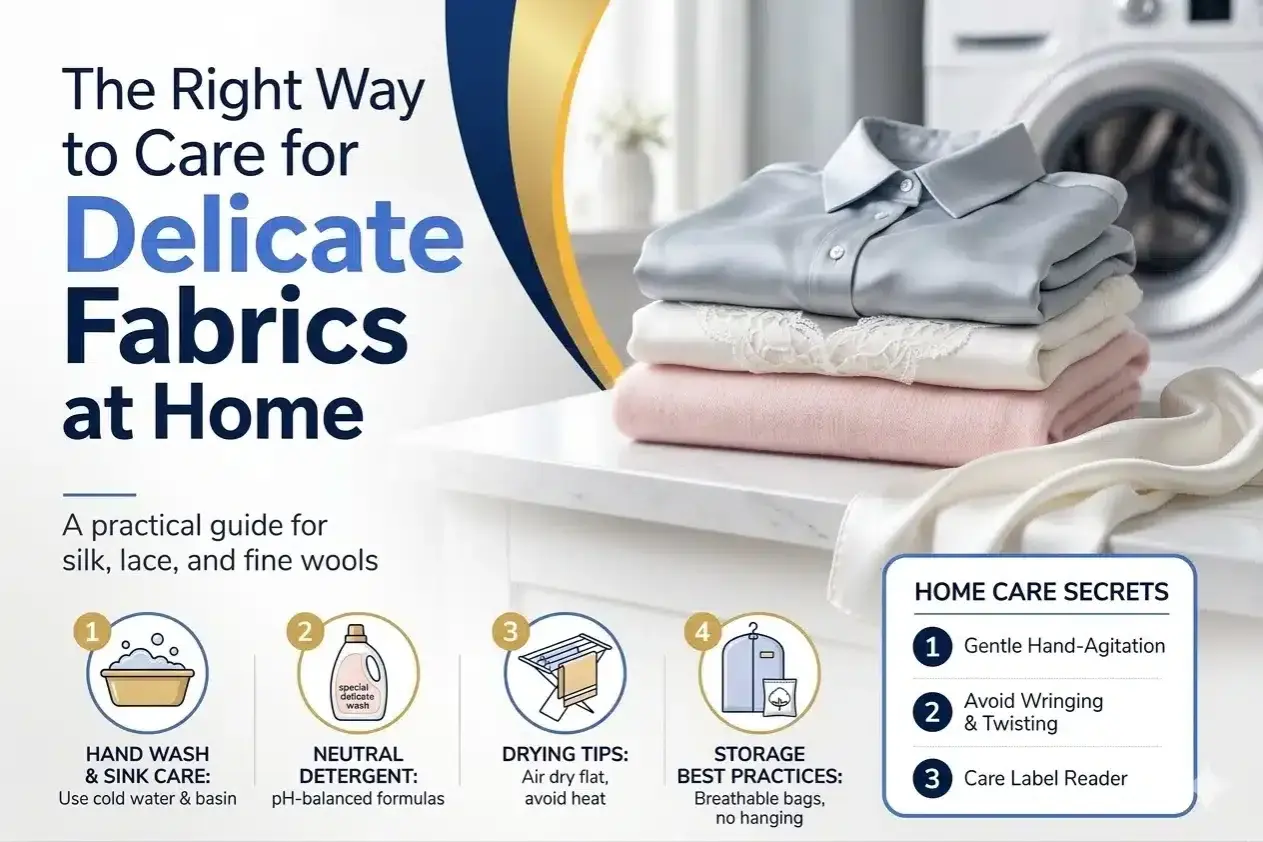
Delicate fabrics need a different routine because heat, friction, and rough handling can change their drape long before they look visibly damaged. In this guide I break down how to recognise fragile textiles, which ones deserve the most caution, and how I wash, dry, press, and sew them without turning a good project into a costly mistake. It is written for the real decisions people make at home, not for textbook theory.
What to remember before you handle fine cloth
- Heat and friction cause most of the damage, not water alone.
- Silk, chiffon, lace, cashmere, viscose, and fine knits all need slightly different handling.
- Cool water, gentle detergent, and minimal agitation solve most home-wash problems.
- Dry flat when the fibre needs support, especially wool and cashmere.
- For sewing, use fine needles, clean seam finishes, and as little unpicking as possible.
What makes a fabric fragile
I classify a fabric as fragile when its weave, fibre, or finish cannot tolerate much abrasion, tension, moisture, or heat. That usually means the cloth is sheer, loosely woven, slippery, or made from fibres that weaken when wet, such as silk, viscose, or some fine wools.
Not every fine fabric is equally vulnerable. A crisp organza, a soft cashmere knit, and a drapey chiffon can all look similar from a distance, but they fail in different ways. One may snag, another may stretch, and a third may lose shape as soon as it gets wet.
- Open structure means threads can shift or catch more easily.
- Weak wet strength means the cloth becomes more vulnerable during washing and rinsing.
- Heat sensitivity can show up as shine, shrinkage, distortion, or even scorch marks.
- Poor recovery means the fabric does not bounce back well after stretching.
Once I understand which of those traits I am dealing with, the rest of the care routine becomes much easier to judge, especially when I move on to fibre-specific handling.
Common fabrics that need careful handling
When I talk about fragile textiles, I am usually thinking about a handful of familiar fabrics that ask for patience rather than force. Some are fragile because they are sheer, some because they are weak when wet, and some because their surface shows every rub and crease.
| Fabric | What makes it tricky | How I usually handle it |
|---|---|---|
| Silk chiffon | Very sheer, slippery, and prone to snagging or fraying | Hand wash or dry clean if the label says so, cut one layer at a time, finish seams with narrow methods |
| Lace | Open structure catches easily and can distort under tension | Wash gently in a mesh bag, avoid hard spin cycles, dry flat if the motif is heavy |
| Silk satin or charmeuse | Shows water spots, pressure marks, and shine from heat | Use cool water only if permitted, press from the wrong side with a cloth |
| Cashmere | Soft fibres can felt, stretch, or pill if handled roughly | Cool wool cycle or hand wash, reshape while damp, dry flat |
| Viscose or rayon | Can weaken when wet and may grow or twist as it dries | Keep washing short and gentle, do not wring, support the garment while drying |
| Organza and tulle | Very light, sheer, and easy to crush or tear | Minimise handling, use fine needles, and press with restraint |
The important point is that these fabrics do not all fail in the same way. Silk hates abrasion, wool hates agitation, viscose hates being stretched while wet, and lace hates snagging. That is why I do not use one blanket rule for all of them.
Knowing the difference helps the next step make sense, because washing is less about brute cleanliness and more about controlling movement, temperature, and time.
How I wash them without overworking the fibres
I always start with the care label, because the label tells me whether the garment was actually tested for machine washing, hand washing, or professional care. In the UK, the symbols are standardised, so a tub, a hand, or a crossed-out wash symbol carries real meaning rather than a vague suggestion.
My default position is simple: if a fragile item can be cleaned without aggressive spinning, hot water, or crowding, I keep the process as short and calm as possible.
Hand washing is the safest option for the most vulnerable pieces
For silk scarves, lace trims, and lightweight blouses, I usually work at around 20 to 30°C, using a small amount of gentle liquid detergent. I dissolve the detergent first, then let the fabric float rather than scrubbing it.
- Fill a clean basin with cool or lukewarm water.
- Mix in a small amount of gentle detergent before adding the fabric.
- Move the cloth through the water softly for 2 to 5 minutes.
- Rinse with water close to the same temperature.
- Press out excess water in a towel instead of twisting or wringing.
If the item is embroidered, vintage, heavily beaded, or made from a structure that could collapse when wet, I do not improvise. That is the point where professional cleaning usually makes more sense than taking a risk at home.
When a machine wash is acceptable
Some fragile garments are genuinely machine-washable, but only if the label allows it. When I do use a machine, I put the item in a mesh bag, wash it with other lightweight pieces only, and choose a gentle or wool-style cycle at about 30°C rather than a standard everyday programme.
- Use a mesh bag for protection against friction.
- Keep the drum lightly loaded, not packed tight.
- Close hooks, zips, and any fastening that could catch.
- Choose the shortest gentle spin that still removes excess water.
- Avoid washing fragile fabrics with towels, denim, or anything abrasive.
If I would not be comfortable washing the item alongside a single pair of jeans, I do not put it in the machine. That rule has saved me from more damage than any clever detergent ever has.
Read Also: What is Lyocell? Your Guide to This Modern Fabric
When I stop and let a cleaner handle it
A label that says do not wash deserves to be taken seriously. I also avoid home washing when a garment has structure, glue, coating, heavy decoration, or a finish that could react badly to water. Tailored jackets, vintage pieces, and some formalwear fall into that category more often than people expect.
In practice, the safest decision is not always the most convenient one. For anything irreplaceable, I would rather pay for the right treatment than create permanent distortion trying to save a few pounds.
Once the fabric is clean, the next challenge is drying and pressing it without changing its shape, which is where many good intentions go wrong.
Drying and pressing without flattening the cloth
This is the stage where I see the most avoidable damage. A silk blouse stretched on the wrong hanger, or a wool knit dried too close to a radiator, can lose its shape even if the wash itself went well.
- Silk, chiffon, and lace usually do best laid flat on a clean towel or mesh rack, away from direct sun.
- Wool and cashmere should be reshaped while damp and dried flat so the weight does not pull the fibres out of line.
- Viscose and rayon need support while drying because the wet fibre is weaker and more likely to grow or twist.
- Organza and tulle should be handled lightly and never crushed under a heavy pile of laundry.
Heat is the real danger here. A low iron setting, usually around the one-dot or low-heat range, is enough for many fragile items when combined with a pressing cloth. I press from the wrong side when possible, use short lifts rather than dragging the iron, and test steam first on a hidden area.
For storage, I keep fully dry items in breathable cotton covers or folded with acid-free tissue if they need extra support. Plastic bags trap moisture, which is not what you want with fine fibres, especially in a damp UK cupboard or an overworked airing space.
That same restraint matters when the fabric is still on the cutting table, because sewing can damage a delicate cloth before the garment is even assembled.
Sewing techniques that protect fragile cloth
When I sew fragile cloth, I change the process before I change the pattern. The aim is to reduce friction, stop the layers from shifting, and finish the seams in a way that respects the fabric instead of fighting it.
- Cut one layer at a time when the fabric is slippery or sheer.
- Use pattern weights and a fresh rotary cutter blade if scissors lift the cloth too much.
- Choose a Microtex or Sharp needle, usually in the 60/8 to 70/10 range for fine woven fabrics.
- Switch to a stretch or ballpoint needle for delicate knits and stretch lace.
- Baste critical seams before stitching, especially on curves or bias cuts.
- Use French seams on straight edges, rolled hems on airy hems, and narrow bias binding where curves would make a French seam bulky.
- Press lightly as you sew, but only with a cloth and minimal heat.
French seams are one of the cleanest finishes I use for sheer fabrics, because they enclose the raw edge and reduce fraying. They are brilliant on straight seams, but I do not force them onto every curve just because they sound elegant. On difficult shapes, a narrow binding or another clean finish often gives a better result.
If the cloth shifts badly, a strip of tissue paper or a soluble stabiliser can help during stitching. I remove it carefully afterwards, because the point is support, not stiffness.
Once those habits are in place, the biggest remaining threat is usually not the construction method, but a few classic mistakes that undo all the careful work.
Mistakes that ruin fragile garments fastest
Most damage I see comes from ordinary habits that are perfectly fine for cotton or denim, but wrong for finer cloth. The mistake is not ignorance so much as treating every fabric as if it belonged to the same category.
- Overloading the wash creates friction and crushes soft surfaces.
- Using hot water by default can shrink, shine, or weaken the fibres.
- Wringing out wet fabric stretches the weave and leaves permanent distortion.
- Hanging heavy wet garments pulls necklines, hems, and sleeves out of shape.
- Pressing from the right side with too much heat can leave shine or scorch marks.
- Unpicking the same seam repeatedly quickly enlarges the needle holes.
- Assuming all sheers are the same leads to using the wrong cycle, wrong needle, or wrong finish.
If I only need one rule to remember, it is this: reduce movement before you increase effort. Gentle washing, careful drying, and thoughtful sewing usually work better than trying to compensate later for rough treatment.
That rule becomes even more useful when I am deciding whether a fabric is actually right for a project in the first place.
The checks I use before buying, cutting, or mending
Before I cut into a fragile textile, I run through a short set of checks. It saves time, avoids waste, and makes the project more realistic from the start.
- Hold it up to the light. If the weave opens too much or the surface looks uneven, I choose a simple pattern rather than a fitted one.
- Pinch and release it. If it does not recover well, I avoid shapes that depend on close structure or heavy tension.
- Test a small corner. I check how it reacts to cool water, a little detergent, and a low iron setting before I commit to the full piece.
- Decide whether it needs support. Lining is a separate inner layer, while underlining is sewn to the fashion fabric for extra control. If a cloth is too transparent or unstable, one of those may be necessary.
- Match the project to the cloth. Scarves, blouses, slips, overlays, and evening details are often better choices than hard-wearing trousers or anything that will be pulled, sat on, or scrubbed regularly.
If you work with delicate fabrics often, I recommend starting with a scarf, camisole, or sleeve sample before you commit to a full garment. Those smaller projects teach you how the fibre behaves without forcing you to learn the hard way on a finished dress.
That is the point I keep coming back to: fragile cloth does not need fear, it needs proportion. Give it the right water temperature, the right amount of movement, and the right finish, and it will reward you with better drape, cleaner seams, and garments that last far longer than their first wash.