The safest needle choice starts with the fabric and the seam you want
- 80/12 universal is a reliable starting point for many everyday woven fabrics.
- Ballpoint or stretch needles protect knits from skipped stitches and damaged loops.
- Jeans or denim needles handle thick seams, canvas, and layered topstitching better than a standard point.
- Smaller sizes suit fine cloth; larger sizes suit denser fabrics and heavier thread.
- Replace the needle often. Singer recommends every 6 to 8 hours of sewing, and dull needles are a common cause of poor stitches.
Start with the fabric, not the packet
I always begin by asking two questions: is the fabric woven or knit, and is it light, medium, or heavy? That tells me far more than the brand name on the needle box. A needle has to do one of three jobs well: slip between woven threads, move between knit loops, or cut a clean path through stubborn material like leather or vinyl.
As a rule, a woven cloth wants a regular or sharp point, a knit wants a rounded or stretch-friendly point, and a thick seam wants a stronger shaft and a bigger eye. Thread matters too. Fine thread behaves better in a smaller eye, while heavier thread usually needs more room or it starts shredding. If I am using a decorative topstitch thread, I stop thinking only about fabric and start thinking about eye size as well.
- Wovens like cotton poplin, linen blends, chambray, and broadcloth usually work best with a regular or sharp point.
- Knits like jersey, rib, and sweatshirt fabric usually need a rounded point so the needle passes between loops instead of cutting them.
- Leather and vinyl need a wedge point that pierces cleanly rather than tearing fibres.
- Thick seams, quilting layers, and topstitching usually need a stronger needle and sometimes a larger eye.
Once that fabric match is clear, the needle family usually picks itself, and the size becomes the next decision.
The main needle types and when I reach for them
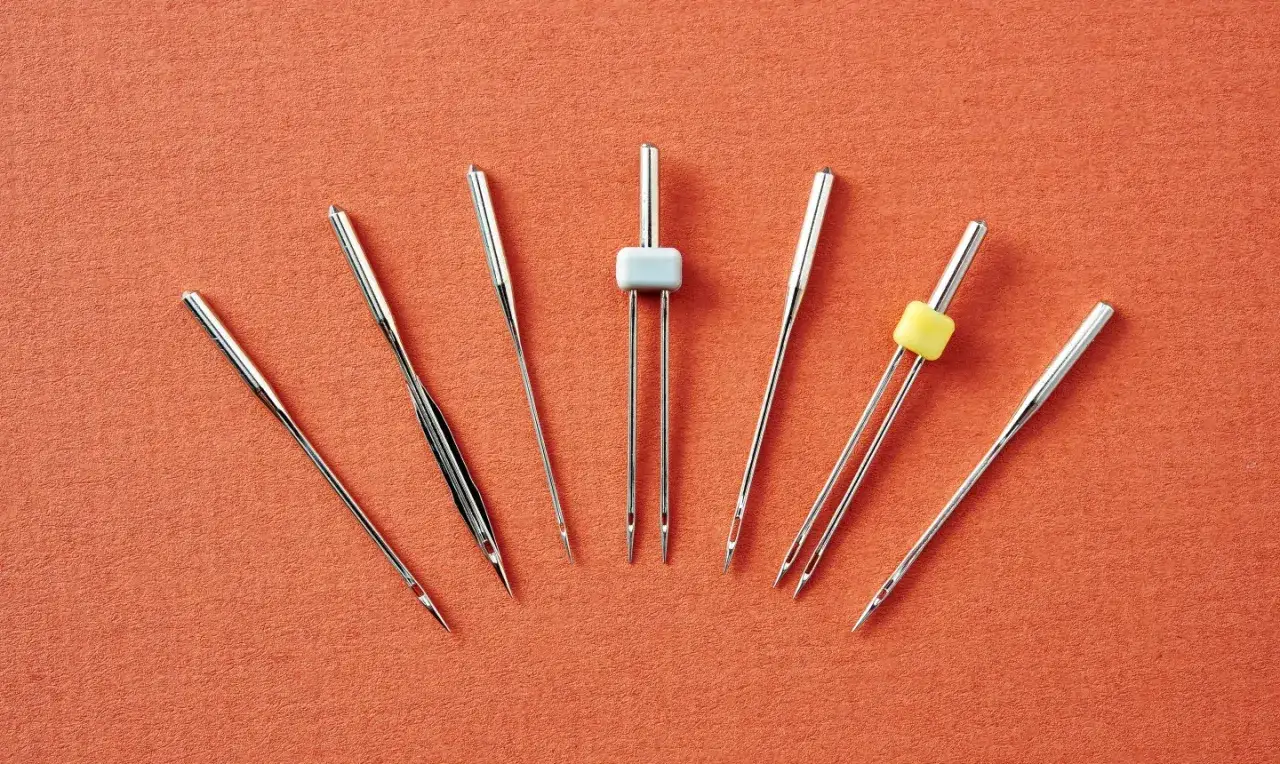
Needle type changes the shape of the point and sometimes the eye, which is why two needles with the same size can behave very differently. Schmetz’s charts place 80/12 near the practical middle of the range, but the point style is just as important as the number.
| Needle type | Best for | Why I use it | Typical size |
|---|---|---|---|
| Universal | Everyday woven fabrics, mixed sewing, general repairs | It is the workhorse choice when I do not need a specialist point. | 70/10 to 90/14 |
| Ballpoint | Jersey, rib knit, interlock, sweatshirt fabric | The rounded tip slips between knit loops and helps reduce skipped stitches. | 70/10 to 90/14 |
| Stretch | Very elastic fabrics, Lycra blends, swimwear | Useful when a standard ballpoint still struggles with high stretch recovery. | 75/11 to 90/14 |
| Jeans or denim | Denim, canvas, thick seams, hard-wearing topstitching | The reinforced shaft handles resistance better than an ordinary needle. | 90/14 to 110/18 |
| Microtex or sharp | Silk, tightly woven cotton, precise seams, fine dressmaking | The slim point makes cleaner holes and gives a neater stitch line. | 60/8 to 90/14 |
| Leather | Leather, suede, vinyl | The wedge point cuts a clean opening instead of punching and tearing. | 80/12 to 100/16 |
| Embroidery | Embroidery thread, decorative stitching, machine embellishment | The larger eye helps protect delicate decorative thread from shredding. | 75/11 to 90/14 |
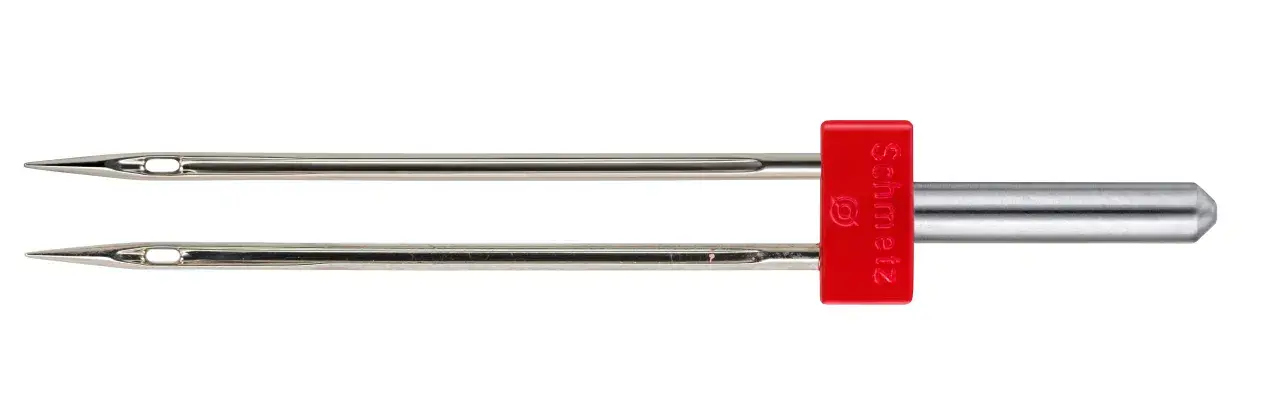
If I only had one box in the sewing drawer, I would still keep a universal 80/12 close to hand, but I would not pretend it can do everything. A twin needle is another useful specialist option for two parallel rows or neat stretch hems, yet it is not a substitute for choosing the right point type in the first place.
The practical lesson is simple: use the needle shape to solve the fabric problem, not just the seam problem. That distinction is what keeps the stitch stable.
How the size number changes the result
Most home needle packs show two size systems, one European and one US. The smaller the number, the finer the needle; the larger the number, the thicker it is. Schmetz’s home-needle charts run from 60/8 up to 120/19, but most domestic sewing lives in the 70/10 to 100/16 range.
| Size | Best used for | What I expect from it |
|---|---|---|
| 60/8 | Silk chiffon, batiste, very delicate lining | Leaves a tiny hole and suits fabrics that bruise easily. |
| 70/10 | Voile, lawn, fine shirting, light dresses | Good when the fabric is light but not ultra-sheer. |
| 80/12 | Quilting cotton, poplin, medium linen blends, most everyday sewing | My default starting point for ordinary projects. |
| 90/14 | Denim seams, corduroy, heavier shirting, multiple layers | Gives the machine a bit more room when the seam starts to thicken. |
| 100/16 | Heavy denim, canvas, coating, thick hems | Useful when a 90/14 begins to bend, skip, or leave weak stitches. |
| 110/18 | Very heavy layers and bulky repairs | Only reach for this when the machine and fabric both justify it. |
I do not jump straight to a bigger needle just because a project feels serious. I size up only when the stitch is cramped, the thread is suffering, or the seam bulk makes the standard size struggle. On a lightweight domestic machine, the manual matters here too; not every model is happy with the heaviest sizes.
That is the reason size and type have to be chosen together. A large needle in the wrong family still gives you the wrong result.
Read the stitch before you blame the machine
A wrong or tired needle usually announces itself quickly. I do not wait for a full disaster; I stop as soon as the machine starts giving clues. Most stitch problems are louder than people think.
- Skipped stitches often mean the point style is wrong for the fabric, especially if a regular needle is on a knit.
- Puckering usually means the needle is too large, the thread is too heavy, or both.
- Fraying thread often points to a burr, a dull eye, or a needle that is too small for the thread.
- Large holes or runs suggest the needle is too big or too aggressive for a delicate cloth.
- Clicking or popping can mean the needle is bent or damaged and should come out immediately.
That is why I keep Singer’s 6-to-8-hour replacement rule in mind. A fresh needle is cheap insurance, and it removes one of the most common causes of uneven stitching before I start adjusting tension that may not be the real problem.
If I hit a pin, sew through a seam that feels unusually hard, or hear the machine complain, I swap the needle instead of trying to finish the project with it.
There is a practical pattern behind all of this: the machine rarely “mysteriously” goes wrong. Most of the time, the needle is simply the first part that tells the truth.
The routine I use to choose a needle in less than a minute
- Identify the fabric family first. I want to know whether I am dealing with woven cloth, a knit, leather, vinyl, or a heavy layered seam.
- Pick the point style before anything else. Regular or sharp for woven fabrics, ballpoint or stretch for knits, denim for hard-wearing seams, and leather for non-woven materials.
- Pick the size second. 70/10 works well for fine cloth, 80/12 suits standard everyday sewing, 90/14 handles heavier fabrics, and 100/16 is there when the seam starts to fight back.
- Check the thread thickness. Heavier thread needs more room, while fine thread behaves better in a smaller eye.
- Test on the real layers, not just a flat scrap. That matters on collars, hems, patch pockets, facings, and quilt sandwiches.
- Keep the machine manual in the loop. Not every domestic machine enjoys the heaviest needles or twin needles.
In UK sewing rooms, the dual size on the packet is normal, so 80/12 means the same thing whether the label looks metric or American. I find that a small mixed pack of universal, ballpoint, jeans, and a fine sharp needle covers most projects without cluttering the drawer.
Once this routine becomes habit, the choice stops feeling technical and starts feeling automatic.
The habit that keeps the choice simple
When I am unsure, I do not reach for the strongest needle first. I start with the smallest sensible option for the fabric, sew a short test seam, and only size up if the stitch proves that it needs more support.
That habit saves fabric, thread, and patience. It also keeps you from blaming tension or timing when the real issue is a blunt or badly matched needle. If you keep a small range of fresh needles in the sewing box, most decisions become straightforward: universal for everyday woven cloth, ballpoint for knits, denim for heavy seams, leather for non-wovens, and a finer sharp needle whenever the fabric deserves a lighter touch.
The best answer is usually the one that respects the fabric first and the machine second.