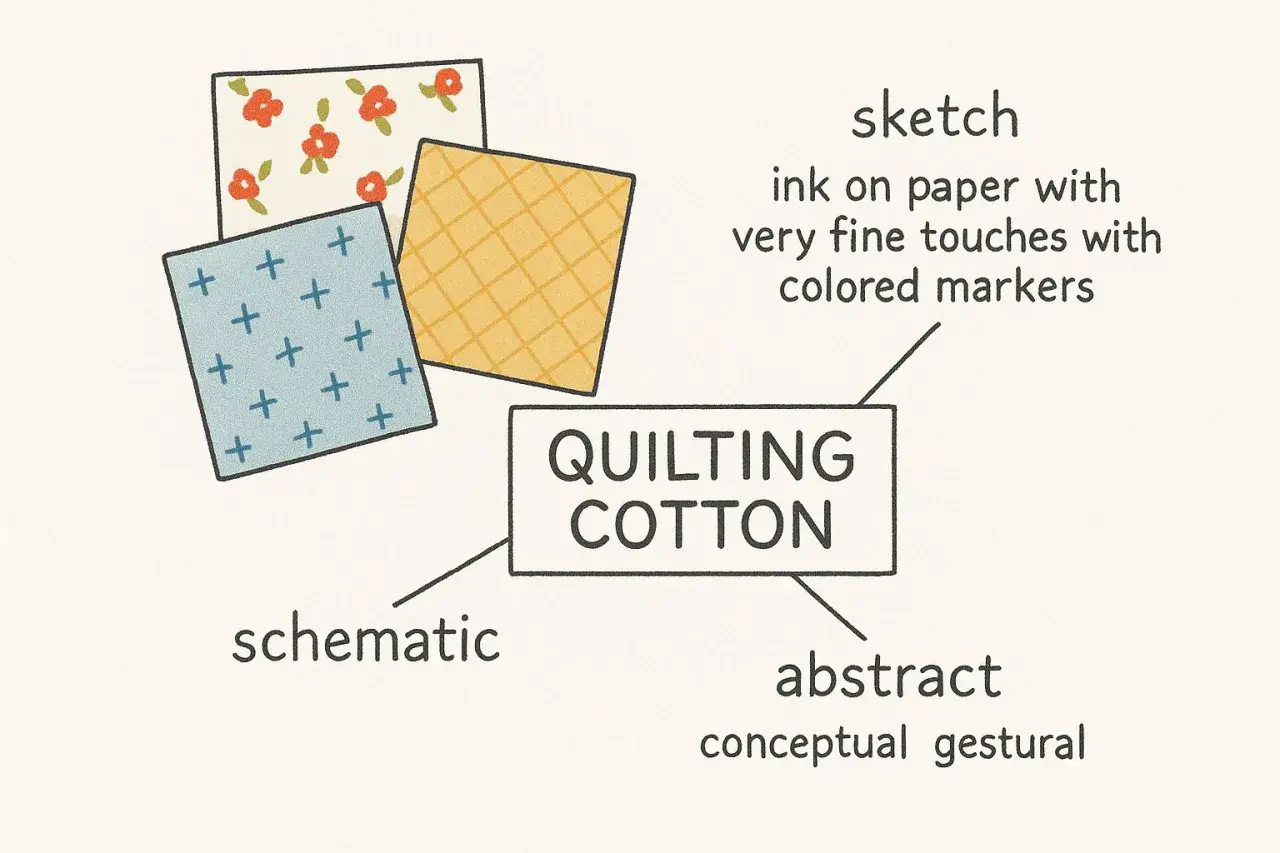
Quilting cotton can absolutely work for clothing, but it behaves differently from fabric made specifically for garments. I use it when I want clean seams, crisp edges, and a shape that stays put; I avoid it when the design needs softness, fluid movement, or a polished fall. This guide breaks down where it shines, where it disappoints, and how to decide before you cut.
The short version is that quilting cotton suits structure better than drape
- Most standard quilting cotton is a medium-weight woven cotton with a crisp hand and limited drape.
- It is a strong choice for shirts, boxy tops, A-line skirts, gathered skirts, shift dresses, and children's clothes.
- It is a poor match for bias-cut, body-skimming, or very fluid garments.
- Prewash it first: cotton can shrink several percent, and some fabrics shrink around 5% or more.
- If a pattern calls for viscose, rayon, silk, or other drapey cloth, quilting cotton usually changes the silhouette.
What quilting cotton really does in clothing
Most quilting cotton is a plain-weave cotton with enough body to hold a fold and enough stability to sew neatly. Standard bolts are often around 44 inches wide, and many sit at roughly 4.3 oz per square yard, or about 150 GSM, though mills and designer lines vary. That body is exactly why quilters love it, and it is also why garment sewists notice the difference straight away: the fabric holds shape instead of flowing.
In practice, that means you get clean seam lines, sharp hems, and clear structure at collars, cuffs, and waistbands. You also get less movement, more visible creasing, and a silhouette that can read boxy if the pattern was drafted for something softer. I think of quilting cotton as a fabric with attitude: it behaves best when the design is already asking for definition. That makes the next question less about fibre content and more about garment style.
Where quilting cotton earns its place in a wardrobe
| Garment type | Why it works | What to watch |
|---|---|---|
| Relaxed shirts and boxy tops | Collars, cuffs, button bands, and straight hems look crisp and intentional. | Choose a pattern with enough ease so the top does not feel stiff across the shoulders. |
| Gathered or A-line skirts | The fabric supports volume, so the shape looks deliberate rather than limp. | Add a lining if the print is light-coloured or the cloth is on the thinner side. |
| Shift dresses and shirt dresses | These silhouettes benefit from structure, especially when the pattern already includes darts or seams. | A fitted bodice needs careful pattern matching and enough shaping to avoid a cardboard feel. |
| Children’s clothes | It is durable, easy to press, and often comes in prints that suit small garments well. | Watch seam bulk at armholes, waistlines, and hems if the design has many layers. |
| Apron-style pieces and pinafores | These garments often look better with a fabric that stands away from the body. | Use the structure on purpose rather than fighting it. |
The common thread is simple: quilting cotton works when the garment can benefit from body. If the pattern already depends on gathers, pleats, darts, or a neat outer shape, the fabric becomes an asset rather than a compromise. That is also the dividing line between a good result and a disappointing one.
When it is the wrong fabric for the job
I would think twice before using quilting cotton for anything that needs softness, swing, or a close skim over the body. Bias-cut skirts, fluid blouses, wrap dresses, drapey trouser styles, and slip-inspired pieces usually lose their intended line when the fabric is too crisp. The same is true for patterns drafted around viscose, rayon, silk, or other fabrics that move easily.
The failure mode is not always dramatic. Sometimes the garment simply looks more square than expected. Other times it wrinkles quickly, pulls oddly across curves, or exposes bulky seam intersections that would disappear in a softer cloth. That can be fine if you were deliberately going for a vintage, structured look, but it is a risky way to end up with a piece you do not wear.
My rule is to be especially cautious when the design language is all about drape, cling, or flow. Quilting cotton does not fake those qualities well, and forcing it usually makes the garment look more homemade than handmade. Once you know that boundary, choosing the right pattern becomes much easier.
How to choose the right pattern before you cut
The safest place to start is the pattern envelope or digital description. If the designer recommends cotton, poplin, lawn, chambray, or another stable woven, quilting cotton is often a realistic option. If the fabric list leans toward viscose, rayon challis, crepe, or silk, I would assume the pattern needs more fluidity than quilting cotton can give.
| Pattern clue | Good sign for quilting cotton | Warning sign |
|---|---|---|
| Silhouette | A-line, shift, oversized shirt, gathered skirt, or other shape with clear lines. | Bias cut, body-skimming, or very fluid styling. |
| Construction | Darts, yokes, button plackets, collars, cuffs, and seams that help the garment hold form. | Very little shaping with a design that depends on natural drape. |
| Fabric callout | Cotton, poplin, lawn, shirting, or chambray. | Viscose, rayon, silk, crepe, or anything explicitly described as floaty. |
| Fit level | Loose or moderately fitted with enough ease to move comfortably. | Tight fit with little room for the fabric to behave. |
I also like to do a simple hand test. Hold the fabric up, pinch it into a fold, and ask whether the shape still looks right when the cloth is allowed to stand away from the body. If it looks convincing with a bit of body behind it, you are probably on safer ground. If it turns stiff and awkward, the pattern may need a different fabric rather than a different size.
That test matters most for fitted bodices, sleeves, and anything with important style lines. The right match saves a lot of unpicking later, and the sewing stage becomes far more straightforward.
Sewing details that make a quilting cotton garment look intentional
Prewash first. Cotton can shrink several percent, and some fabrics can lose around 5% or even a little more, so skipping that step is how you end up with sleeves or hems that behave differently after the first wash. I also prewash because it helps reveal whether a print bleeds or a finish changes the hand of the cloth. After washing, press the fabric flat before you cut anything.
From there, the little finishing choices matter more than people expect. A fresh universal needle usually works well; on many midweight quilting cottons I start with an 80/12 and move up if the fabric feels dense or the seams start to struggle. Seam finish is worth thinking about too: French seams can look beautifully clean on lightweight garments, while overlocked or zigzagged edges are usually enough for casual pieces. If the project has collars, cuffs, facings, or plackets, use lightweight interfacing so the fabric supports the shape without turning cardboard-stiff.
Pressing is not optional with this fabric. Quilting cotton responds well to steam and pressure, and tidy pressing often makes the difference between a garment that looks deliberate and one that looks rushed. I also grade bulky seam allowances at corners and intersections, especially around waistlines and armholes, because the fabric can stack up quickly. Small habits like that are not glamorous, but they do a lot of the heavy lifting.
If you want the garment to look polished, keep the construction calm and clean. Straight topstitching, careful grain alignment, and well-chosen facings will do more for the final result than almost any decorative trick.
Better alternatives when you want more drape
Sometimes the answer is not to make quilting cotton work harder. It is to choose a cloth that already behaves the way the pattern needs. If you want to keep a cotton feel but soften the result, I usually reach first for cotton lawn or cotton poplin. If you want a more relaxed, casual look, chambray is a good middle ground. For breathability and texture, linen or a linen blend is often a better fit. And when the design really depends on movement, viscose or rayon usually gives the silhouette the right amount of fluidity.
| Fabric | Feel and drape | Best for | Why choose it over quilting cotton |
|---|---|---|---|
| Cotton lawn | Light, smooth, and softer against the skin. | Blouses, dresses, and shirts with a gentler fall. | You keep the cotton comfort but gain a finer, less rigid hand. |
| Cotton poplin | Crisp but smoother and usually a little more refined. | Shirts, shirt dresses, and neat everyday separates. | It gives structure without the same level of stiffness. |
| Chambray | Casual, breathable, and slightly more relaxed. | Shirts, summer dresses, and easy trousers. | It looks less craft-like and usually wears more softly. |
| Linen or linen blend | Airy, textured, and increasingly soft with wear. | Loose shirts, skirts, and warm-weather dresses. | It handles heat better and suits garments that should move. |
| Viscose or rayon | Fluid and drapey with a softer silhouette. | Wrap dresses, wide sleeves, and swishy skirts. | It follows the body instead of standing away from it. |
If you love the prints that often come on quilting cotton but want a better garment result, look for a lighter cotton woven with a similar print scale. That small change often preserves the aesthetic while fixing the behaviour.
The rule I use before I commit to the cut
My practical test is blunt: if the garment looks better standing slightly away from the body than hanging softly from it, quilting cotton is probably fair game. If the design depends on movement, softness, or a clean liquid line, I reach for something lighter and more fluid. That one decision does most of the work.
- Use quilting cotton for structure, shape, and graphic prints.
- Avoid it when the silhouette needs drape more than definition.
- Prewash, press, and test the hand before you cut the real fabric.
- Choose patterns that already suit stable wovens, not fabrics with a lot of movement.
So yes, quilting cotton can be a useful clothing fabric, but it is best treated as a deliberate choice rather than a universal substitute. When the pattern and the fabric agree, it can make sharp, satisfying garments; when they do not, the mismatch shows quickly. I would trust it for a crisp shirt, a full skirt, or a structured dress, and I would leave it alone for anything that is meant to float.