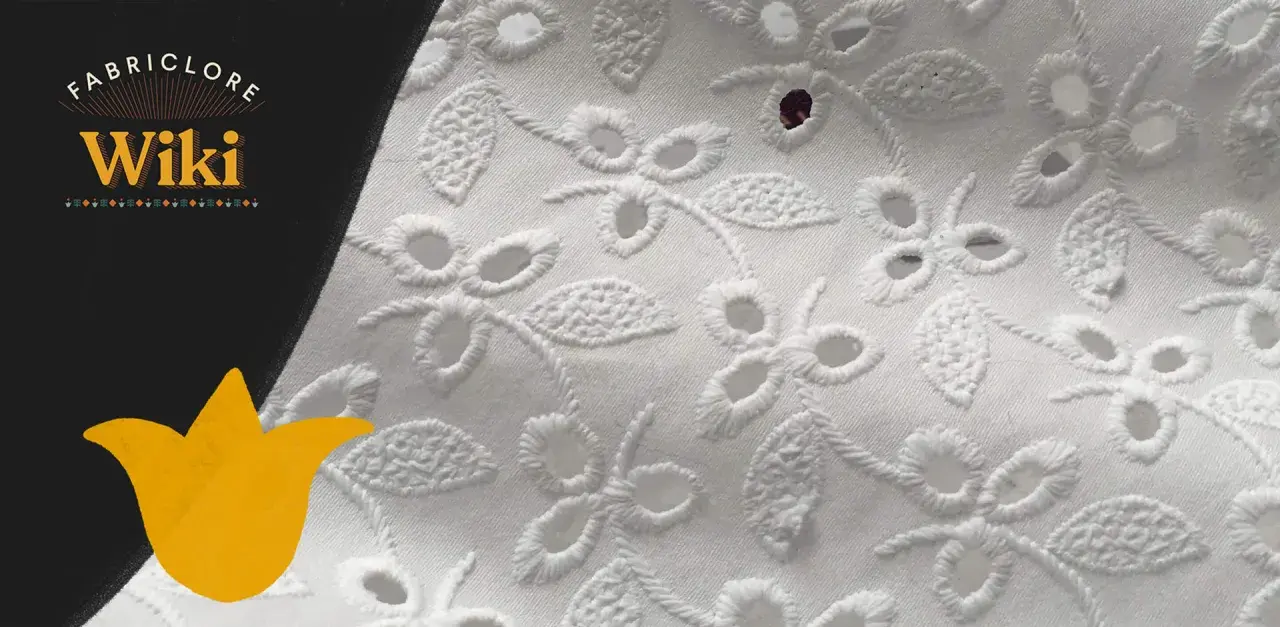
Eyelet fabric sits in a useful middle ground between decorative and practical: it has enough pattern to feel special, but it can still work hard in summer clothing, soft furnishings, and trim details. To answer what eyelet fabric is in practical terms, think of a woven cloth with small cut-outs that are finished with embroidery so the openings stay neat and decorative. I’m going to unpack how it is made, what gives it its character, how it differs from lookalike fabrics, and how to sew and care for it without flattening the detail.
Eyelet is a decorative openwork fabric that looks light but still has structure
- In the UK, you will often see it called broderie anglaise.
- It is usually made by cutting small holes into a woven base and finishing the edges with embroidery stitches.
- Most versions are lightweight and breathable, which makes them popular for warm-weather garments.
- Many eyelets are semi-sheer, so lining or underlayers are often part of the design.
- The openwork improves airflow, but it also means seams, hems, and closures need more careful finishing.
- It is not the best choice for every project, but it excels when you want texture, softness, and a romantic surface.
What eyelet fabric actually is
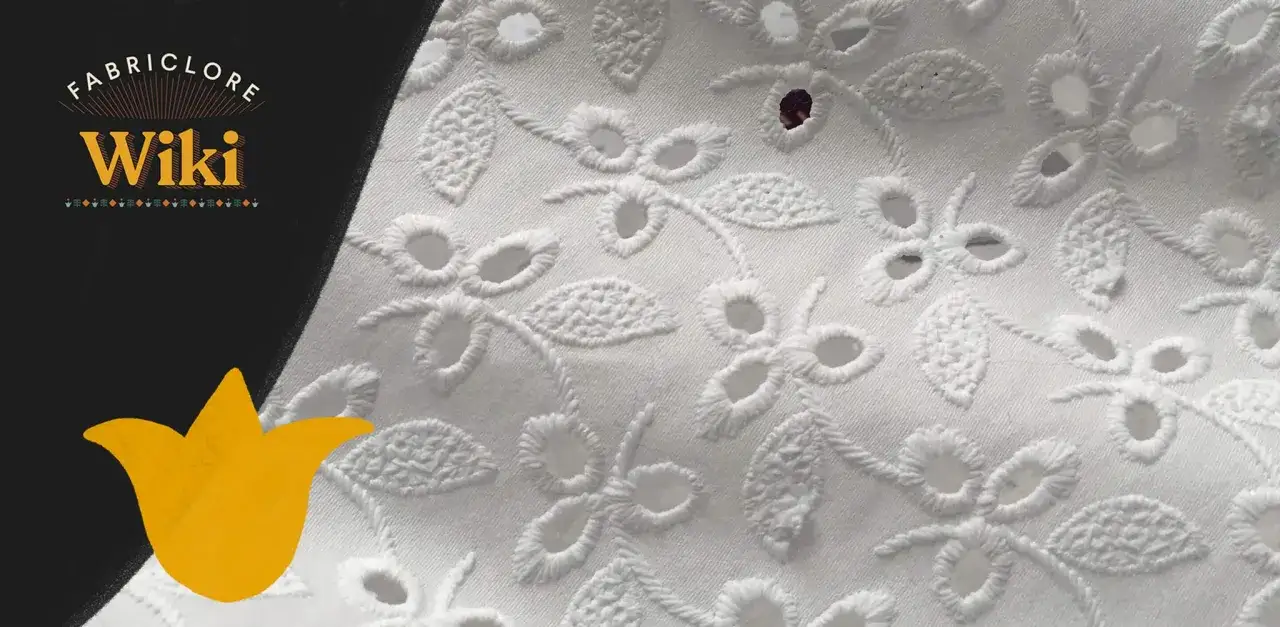
Eyelet fabric is a decorative cutwork textile. The base cloth is typically woven, then small round or oval openings are cut into it and bound with embroidery stitches, often in a repeating floral, geometric, or scalloped pattern. That is the key detail people miss: the holes are not there by accident, and they are not simply the result of a loose weave. They are designed openings that are reinforced so the fabric keeps its shape.
In British sewing and dressmaking, you will often hear the term broderie anglaise. In practice, it usually refers to the same family of eyelet fabrics, especially the whitework styles associated with summer blouses, dresses, nightwear, and baby clothes. I treat it as a fabric category rather than a single exact construction, because the base cloth can vary quite a bit: cotton lawn, cotton poplin, linen blends, and occasionally synthetic blends all appear on the market.
This distinction matters. Eyelet is not the same as true lace, even though it can look lace-like from a distance. Lace is built from thread structure; eyelet begins with a fabric ground and then removes sections from it. That difference affects drape, transparency, seam behaviour, and how much support the garment needs. Once you understand the construction, it becomes much easier to choose the right project for it.
The next question is how to spot a well-made piece before you cut into it, because not all eyelet behaves the same way.
How to recognise good eyelet fabric
When I inspect eyelet, I look beyond the pretty holes and check the construction underneath. A good version feels balanced: the embroidery is clean, the cut-outs are evenly spaced, and the base fabric is stable enough to hold the pattern without sagging. A poor version often looks attractive on a roll but starts to reveal weak spots once you handle it, especially near seams or curved edges.
| Characteristic | What you should notice | Why it matters |
|---|---|---|
| Hole finish | Each opening should be neatly bound with embroidery or dense stitching | Clean finishing reduces fraying and keeps the pattern crisp |
| Base fabric | The ground cloth should feel stable, not flimsy or distorted | A weak base makes sewing harder and can stretch out of shape |
| Pattern density | Motifs may be sparse, all-over, or border-based | Density affects opacity, drape, and where you can place seams |
| Surface texture | The embroidery should sit smoothly without rough ridges | Rough stitching can catch on threads, jewellery, or seam finishes |
| Edge design | Some fabrics have a scalloped border or decorative selvedge | That edge can be a useful hem, sleeve finish, or design feature |
I also check how the fabric behaves when held to the light. If the holes are large and the ground cloth is thin, the cloth may need lining even if the seller describes it as dress weight. That leads neatly into the more practical part of the story: how eyelet feels in wear and in sewing.
What it feels like to wear and sew
Eyelet fabric usually feels airy, soft, and lightly structured at the same time. A cotton version can be crisp enough to hold a shape, while a viscose or blend version may drape more fluidly. That range is useful, but it also means you cannot assume one eyelet behaves like another. Two bolts with the same look can sew very differently once they hit a seam allowance, a dart, or a hem.
| Property | Typical behaviour | Practical effect |
|---|---|---|
| Breathability | High, especially in cotton and linen-based versions | Good for warm-weather garments and layered styling |
| Opacity | Often semi-sheer, sometimes quite open | May need lining, underlining, or a camisole |
| Drape | Ranges from crisp to soft depending on fibre content | Affects silhouette, fullness, and how seams settle |
| Stability | Moderate, but weaker around the cut-out areas | Needs careful handling at shoulders, zips, and button bands |
| Texture | Raised embroidery and open spaces create visual depth | Looks richer than plain cotton without needing extra trims |
From a sewing perspective, the openwork is the most important limitation. The fabric can be beautiful, but it is less forgiving than plain lawn or poplin when you need sharp corners, clean closures, or heavy topstitching. That is why comparing it with other decorative fabrics helps prevent wrong expectations.
How it differs from lace and other lookalikes
Eyelet often gets grouped with lace, but the construction is different enough that I would not treat them as interchangeable. In the UK, broderie anglaise is the name you will most often see in shops for this same eyelet-style look, especially in cotton dress fabrics. If you are shopping online, it helps to read the description carefully rather than relying only on the images.
| Fabric | How it is made | Best for | What to watch for |
|---|---|---|---|
| Eyelet / broderie anglaise | Cut-outs in a woven base, finished with embroidery stitching | Summer garments, blouses, dresses, curtains, table linens | Can be semi-sheer and needs clean seam finishing |
| Lace | Pattern built from threads rather than cut openings in fabric | Overlays, trims, formalwear, decorative panels | Often more delicate and less stable for construction seams |
| Swiss dot | Woven or printed base with small raised dots | Soft blouses, dresses, child-friendly garments | Has texture, but not the same open airflow or transparency |
| Embroidered cotton lawn | Plain woven fabric with surface embroidery only | Shirts, dresses, skirts, statement linings | Less airy than eyelet, but usually easier to cut and sew |
That comparison is useful because it shows where eyelet earns its place: it gives you the softness of embroidery, the visual interest of cutwork, and more structure than many people expect. The trade-off is that you have to design around the holes instead of pretending they are just decoration.
Where eyelet shines and where it struggles
I reach for eyelet when the project benefits from texture, airflow, and a light romantic finish. It works especially well on shapes that are not overly tight, because the fabric wants room to move and breathe. It is less convincing when the garment needs strong shaping, a highly engineered fit, or a lot of abrasion resistance.
| Project | Why it works | Common adjustment |
|---|---|---|
| Summer dresses | The openwork keeps the garment visually light and physically cooler | Line the bodice or skirt if transparency is an issue |
| Blouses and shirts | Eyelet adds interest without needing heavy trims | Use a softer underlayer or a neat facing system |
| Children’s clothing | It looks delicate and fresh, especially in cotton versions | Choose soft finishes and avoid scratchy internal seams |
| Curtains and table linens | The pattern reads well in a room and filters light beautifully | Check border placement and repeat before cutting |
| Skirts with fullness | Gathering or flare helps the fabric move naturally | Add a lining if the fabric opens up too much in sunlight |
| Tailored trousers or close-fitting jackets | Usually a poor fit for the fabric’s structure | Use only if the design is heavily supported and intentionally decorative |
The fabric is also a strong choice for border details, sleeves, yokes, and hems, because those areas let the decorative selvedge do some of the work. I would be more cautious with fitted waistbands, curved facings, and areas that take repeated stress, unless the pattern is reinforced properly. That brings us to the part most sewists care about: how to handle eyelet cleanly at the machine.
How to sew it cleanly without losing the detail
Eyelet rewards preparation. The more carefully you plan the cutting and finishing, the better the fabric looks once it is made up. I always start with prewashing, because cotton eyelet can shrink a little and the embroidery may relax after the first wash. Then I check the repeat and border placement before I cut a single piece, especially if the fabric has a scalloped edge that I want to use as a hem.
- Prewash and press first. For cotton-based eyelet, I treat prewashing as non-negotiable, because even a small amount of shrinkage can distort the cut-out pattern.
- Use a sharp, fine needle. A 70/10 or 80/12 sharp needle usually works well; I move finer for lightweight cotton lawn and slightly heavier if the fabric is dense.
- Stabilise weak areas. Lightweight interfacing, stay tape, or a plain underlining helps at zips, button bands, shoulder seams, and closures.
- Choose clean seam finishes. French seams, narrow overlocked seams, and neat bindings are often better than bulky finishes that show through the openwork.
- Test your stitch length. I often start around 2.0 to 2.5 mm on a straight stitch and adjust if the fabric puckers or shifts.
- Line where necessary. If the garment is likely to be sheer, line the bodice, skirt, or yoke rather than trying to hide transparency with heavy layers later.
- Place hems carefully. A scalloped border can become the hem itself, which is usually cleaner than forcing a blind hem through open holes.
If something goes wrong, it is usually one of three problems: puckering, fraying, or visibility of the inner construction. Puckering usually means the stitch is too tight or the fabric was not supported enough. Fraying means the seam finish was too weak for the base cloth. Visibility means the design needed lining or underlining from the start, not as an afterthought. Those are fixable, but they are easier to avoid than to rescue.
Why it still belongs in a modern fabric stash
I keep eyelet in the category of fabrics that look simple but repay careful selection. It gives you texture without clutter, and it can make a plain shape feel intentional without adding extra trim or embellishment. That is why it keeps showing up in summer wardrobes and in soft furnishing projects: it has enough character to stand on its own, yet it does not usually overpower a pattern.
The real trick is matching the cloth to the job. A crisp cotton eyelet is excellent for dresses, blouses, and children’s pieces that need breathability and shape. A softer or more open version may be better for drapier garments, linings, or decorative home projects. If you remember nothing else, remember this: eyelet looks delicate, but the best results come from treating it like a fabric with structure, not just decoration.
When I choose it well, the fabric does half the design work for me. When I choose it badly, the openwork becomes a problem I have to solve later. That is the practical difference between admiring eyelet on the bolt and using it successfully in a finished piece.