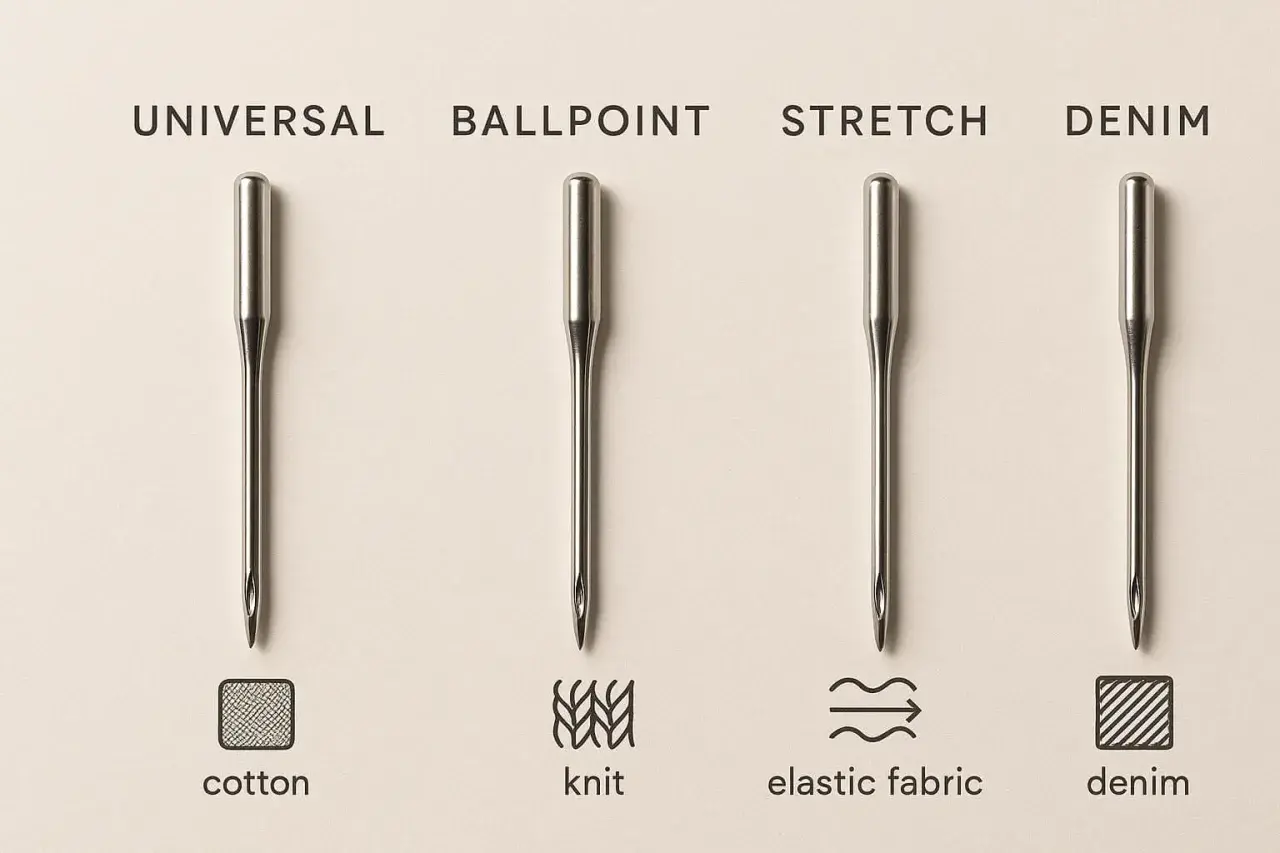
The ball point needle vs universal debate comes down to fabric structure, not brand preference. A ballpoint needle is built to move between knit loops without cutting them, while a universal needle is the more versatile option for woven fabrics and some stable knits. I am going to show you where each one works best, what the wrong choice looks like on the machine, and how I would size the needle for a clean stitch line.
The fastest way to choose between these two needle types
- Use a ballpoint needle for knit fabrics such as jersey, rib knit, and most T-shirt materials.
- Use a universal needle for woven fabrics such as cotton, poplin, lawn, chambray, and linen blends.
- A universal needle can work on some stable knits, but it is still a compromise rather than the best match.
- If a knit starts skipping stitches, the needle is often the problem before the machine is.
- Needle size matters as much as needle type, especially in domestic sewing where 70/10, 80/12, and 90/14 do most of the work.
How the two needles differ in practice
The difference becomes clear the moment the needle meets the fabric. A ballpoint needle has a more rounded tip that slips between the yarns in a knit, while a universal needle has a slightly rounded point that can handle a wider range of fabrics, but still behaves more like an all-purpose compromise. Ballpoint needles are often sold as jersey needles, which is useful to know when you are reading packs in UK sewing shops.
The point is the real story here. On a knit, you want the needle to part the loops rather than slice through them. On a woven fabric, you usually want a cleaner, more direct penetration so the seam lies neatly. That difference affects stitch quality, fabric damage, and how much troubleshooting you do later.
| Feature | Ballpoint | Universal |
|---|---|---|
| Tip shape | Medium rounded point | Slightly rounded point |
| Also known as | Jersey needle | All-purpose needle |
| Best on | Knits, jersey, rib knit, stretch fabrics | Wovens, general dressmaking fabrics, some stable knits |
| What it does | Moves between loops and reduces damage to knit structure | Balances piercing and thread displacement across many fabrics |
| Main weakness | Can feel less crisp on woven fabric | Can cut knit fibres and trigger skips or small holes |
In plain terms, the ballpoint needle is the specialist and the universal needle is the compromise. That is not a criticism of either one; it is exactly why both belong in a sewing box. Once you understand that, the practical choice becomes much easier.
That sets up the real question: when should you reach for the knit-friendly option, and when is the all-purpose needle the cleaner fit?
When a ballpoint needle is the safer choice
I reach for a ballpoint needle whenever the fabric is built from loops rather than a tight weave. Jersey, rib knit, interlock, sweater knit, and most T-shirt fabrics all fit that description, because the needle has to move through the structure instead of punching a hole through it. In those fabrics, a universal needle can leave tiny holes, encourage runs, or make the seam look slightly battered even if the machine is threaded correctly.
In shops and pattern instructions, you may also see this needle described as a jersey needle. The name changes, but the purpose does not: protect the knit and keep the stitch line smooth.
- Use it for T-shirts and casual jersey when you want the seam to stay neat and low risk.
- Use it for cuffs, neckbands, and waistbands where stretch and recovery matter.
- Use it for sweater knits and softer double knits to reduce snags and visible punctures.
- Use it for jersey repairs when you want the needle mark to be as discreet as possible.
If the fabric is highly elastic, especially with elastane or spandex, I often step up to a stretch needle rather than forcing a standard ballpoint to do everything. That small distinction matters because a stretch needle is tuned to reduce skipped stitches on very elastic fabric. The practical takeaway is simple: for knitwear, start with ballpoint; for very stretchy knits, test a stretch needle if the stitches are not happy.
That makes the ballpoint the safer default for knitwear, but it is not the only needle worth keeping nearby. The universal needle still has a large role in everyday sewing, and it is better than many sewists expect.
When a universal needle makes more sense
A universal needle is my everyday choice for woven fabrics: cotton poplin, lawn, chambray, quilting cotton, linen blends, shirt fabric, and most dressmaking fabrics that hold their shape. Its slightly rounded point is designed to work across a broad range of materials, which is useful when you are sewing something that is neither extremely fine nor especially stretchy. It gives a cleaner seam line on woven cloth because it is meant to pierce the structure rather than push the threads aside.
I also use a universal needle on stable, low-stretch fabrics when I want a straightforward all-round option and do not want to stop and change needles for every small job. But I treat that as a convenience choice, not a perfect match. On knit fabric, a universal needle can behave well enough on some firm ponte or interlock, yet it is still more likely to cause skipped stitches or tiny holes than a proper ballpoint.- Choose universal for woven cottons when you want crisp, predictable seams.
- Choose universal for medium-weight general sewing when the fabric is not delicate and not especially stretchy.
- Choose universal for mixed projects only when the fabric is stable enough to tolerate a compromise.
There is one trap here: a universal needle can make a knit project seem “almost fine,” which is often worse than a clear failure. If the seam looks acceptable at first but starts to ladder, pucker, or pop when the garment is worn, the needle was probably the wrong tool from the start. That is why the symptoms matter as much as the fabric name.
Once you know the common failure signs, the next step is choosing the right needle before they appear.
What goes wrong when you pick the wrong needle
Most needle problems announce themselves in the stitch, not on the packaging. When I see skipped stitches, shredding, or little holes beside the seam, I assume the needle-fabric match is wrong before I blame tension or the machine. A blunt or damaged needle can do the same thing, so I look at the fabric first, then at the condition of the needle.
| What you see | Likely cause | Better move |
|---|---|---|
| Skipped stitches on jersey | Universal needle on a knit, or a dull needle | Try a ballpoint needle, or a stretch needle if the fabric is very elastic |
| Tiny holes around the seam | Needle tip is too aggressive for the fabric | Switch from universal to ballpoint |
| Puckering on woven cotton | Needle size is too large, or the needle is worn | Use a smaller universal needle |
| Thread shredding | Eye too small, damaged needle, or wrong needle type | Replace the needle and check the size |
| Popping or knocking sound | Bent, blunt, or incorrectly inserted needle | Stop and replace it immediately |
I think this is the part people overlook most often. A bad needle choice can mimic a machine fault, and that wastes time. If the problem appears right after a fabric change, the fabric and needle combination is the first thing I would adjust.
Once the type is right, size becomes the next lever that changes the result.
How I match needle size to fabric weight
Needle type is only half the decision. Size matters just as much, because a needle that is too heavy leaves bigger holes and distorts light fabric, while a needle that is too fine can deflect, skip, or break on thicker cloth. On UK packaging you will usually see both size systems, so 80/12 means European 80 and US 12, and that is the size I reach for most often on everyday sewing jobs.
| Fabric or task | Good starting size | Why it works |
|---|---|---|
| Very light jersey, fine knits | 70/10 ballpoint | Smaller hole, less distortion |
| Everyday T-shirt jersey | 80/12 ballpoint | Balanced choice for most knitwear |
| Heavier knits, fleece, sweatshirt fabric | 90/14 ballpoint or stretch | Better support through thicker layers |
| Light woven cotton, lawn, poplin | 70/10 or 80/12 universal | Clean seam without over-punching the cloth |
| Medium woven garments | 80/12 or 90/14 universal | Works well on shirts, dresses, and everyday tailoring |
Thread can change the answer too. If I am using a thicker topstitch thread, I usually go up a size so the eye and groove do not fight the thread. The rule I trust is simple: start with the fabric, then check the thread, then test on an offcut. That is faster than repairing a seam that should have been right the first time.
That leaves one practical question: which few needles are actually worth keeping within reach so you do not have to overthink every project?
The smallest needle kit that covers most sewing jobs
If I were building a practical needle kit for a domestic machine, I would keep it small on purpose: one pack of universal needles in 80/12, one pack of ballpoint needles in 80/12, and a second universal pack in 70/10 or 90/14 depending on the fabrics I sew most. That combination covers a surprising amount of everyday work without turning the sewing box into clutter.
- 80/12 universal for most woven garments and general sewing.
- 80/12 ballpoint for everyday jersey and knitwear.
- 70/10 universal for lighter fabrics that need a gentler touch.
- 90/14 universal for heavier wovens and more structured fabric.
- Stretch needle if you regularly sew activewear or very elastic knits and want fewer skipped stitches.
That is the setup I would trust for most home sewing in the UK: simple, not over-specialised, and flexible enough to cover the fabrics people actually buy. If you remember only one thing, make it this: use a ballpoint for knits, a universal for wovens, and let the fabric decide the size before you touch the machine settings.