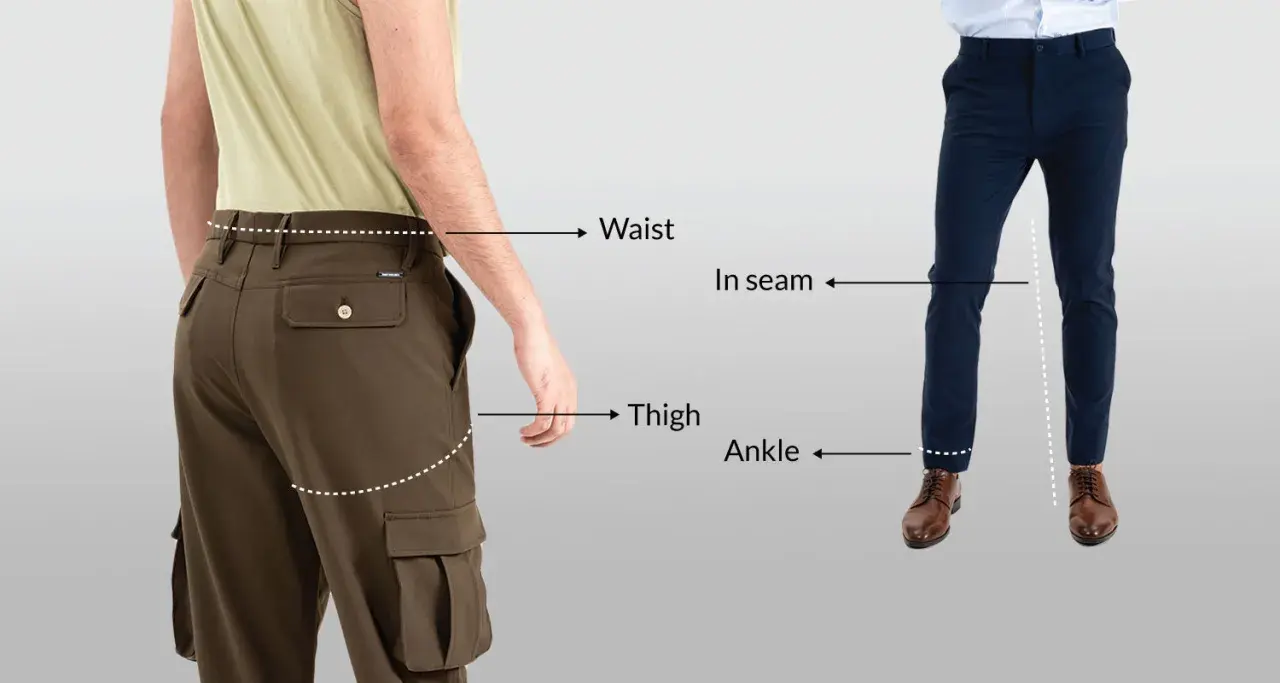
Finding the line between a close fit and a bad one is mostly about movement and fabric behaviour. In Britain, I would usually call them trousers, but the fit clues are the same for jeans, chinos, and dressier pairs. Knowing how to tell if pants are too tight helps you avoid waistband digging, thigh strain, and that stretched look that never really settles down.
The fit clues that matter most
- A good pair feels secure at the waist without biting, rolling, or leaving marks.
- You should be able to sit, step, and bend without the fabric fighting back.
- Diagonal drag lines, pocket flare, and a fly that pulls are stronger warning signs than a simple snug feel.
- A little wrinkling behind the thigh when you sit is normal; sharp tension lines at rest are not.
- If the problem is only in one area, the best fix is often a different cut or a small alteration, not just a bigger size.
The fastest signs the fit is off
The quickest clue is discomfort that keeps demanding attention. If you are adjusting the waistband every few minutes, unfastening the top button when you sit down, or feeling pressure across the hips after only a short wear, the trousers are probably too close to the body for their own good. A properly fitted pair should feel secure, but it should not make you think about it every time you move.
I also watch for signs that the cloth is being forced into a shape it was never meant to hold. That includes a waistband that rolls, a fly that pulls open slightly, pockets that bow away from the body, or seam lines that stop hanging straight. Those are not style details. They are the garment telling you that the balance is wrong.
- The waistband bites when you sit or breathe deeply.
- The button or zip feels strained, especially after a meal or a long walk.
- The front pockets become hard to use because the opening is distorted.
- The trousers leave red marks after only 10 to 15 minutes.
- You need a belt just to keep them tolerable, not just to finish the outfit.
If that list sounds familiar, the next step is to look at the fabric itself, because cloth usually shows the problem before the label does.
Read the fabric before you judge the size label
When I am checking fit, I look for drag lines, which are tension wrinkles that point towards the place that is under strain. In sewing, they are one of the most useful clues you can get because they show not just that something is tight, but where the extra room is missing. A pair can look tidy from one angle and still be fighting your body in the seat, thigh, or crotch.
| What you see | What it often means | What I would do next |
|---|---|---|
| Diagonal lines radiating from the crotch | Not enough room through the rise, seat, or upper thigh | Try a roomier cut or a deeper rise before sizing up blindly |
| Horizontal lines under the seat | The back rise may be too short, or the seat lacks sitting ease | Look for more length in the back rise or a fuller seat shape |
| Pockets that flare away from the body | The hips or seat are being stretched too tightly | Move to a cut with more room through the hip block |
| Lines across the front thigh | The thigh is too narrow or the leg opening is too slim | Choose a straighter leg or more thigh width |
| Fabric that goes semi-sheer when stretched | The cloth is under too much tension for the weight and weave | Change to a denser fabric or a style with more ease |
One caution here: not every wrinkle is a fault. A small amount of horizontal wrinkling behind the thigh when you sit is normal and is often called sitting ease. That is the room the garment needs so you can bend your knees without splitting seams or flattening the seat. The difference is simple: normal sitting ease disappears when you stand, while tightness keeps pulling even when you are upright. Once you can spot that difference, movement tests become much easier to read.
Run a few movement tests before you decide
A pair can feel acceptable when you are standing still and fail the moment you actually use your body. I always tell people to test trousers as if they were going to wear them for an ordinary day, not a display pose in front of a mirror. If the fit survives sitting, walking, climbing stairs, and reaching into pockets, it is much closer to usable.
- The sit test - Sit on a chair, then on a lower seat if possible. You should not feel the waistband drive into your stomach or the back rise pull sharply down.
- The stair test - Walk up a few steps at a normal pace. If the thigh or crotch feels blocked, the leg line is too close.
- The pocket test - Put a hand in each pocket. If the opening collapses or twists, the hip and seat are under strain.
- The bend test - Bend forward and squat lightly. Tight trousers will usually show themselves here faster than anywhere else.
- The three-finger check - At the waistband, you should usually be able to slide in roughly three fingers without the fabric cutting into the skin. That is a useful rule of thumb, not a law, but it is a good reality check.
What I look for is not perfection. I look for whether the trousers let the body move naturally. If you have to change how you sit or walk just to keep them wearable, the fit is already too restrictive, and the question becomes where the pressure is coming from.
Where the strain sits changes the fix
This is the part many people miss. A pair of trousers can feel too tight overall, but the underlying problem may be very specific. If you size up without diagnosing it, you can end up with a bigger waist, a looser seat, and the same cramped thighs you started with. In pattern-cutting terms, the block is the underlying shape of the garment, and if the block does not suit your body, the whole pair will feel wrong.
| Area | Common sign | Likely cause |
|---|---|---|
| Waist | Digging, rolling, or a button that feels one breath away from popping | Waist measurement is too small, or the rise is not giving enough room |
| Seat | Pockets flare, back waistband dips, fabric stretches across the bum | The seat needs more depth or width |
| Thighs | Walking feels restricted and seams pull towards the crotch | The upper leg is too narrow for the body shape |
| Crotch and rise | You feel blocked when sitting, or the front seam pulls hard | The rise is too short or the crotch curve is too shallow |
| Calves and hem | The lower leg feels trapped or the fabric climbs up as you move | The leg shape is too slim through the calf |
That is why a pair can be technically the right size and still be wrong for the body. Denim cuts, tailored trousers, and stretch styles all handle these pressure points differently. The next section is about deciding whether a small correction is enough, or whether you need a different cut altogether.
What to do when the pair is only slightly off
If the trousers are only mildly restrictive, I would not rush to write them off. Sometimes a slightly softer fabric, a short break-in period, or a good alteration is enough. But I would separate mild snugness from genuine tightness. Mild snugness feels close and tidy; genuine tightness changes how you move.
- Choose a different cut if the same issue keeps appearing in the same place, such as every pair feeling tight in the thigh or seat.
- Look for more forgiving fabric if the cloth is rigid. A bit of stretch can help, but it should support the fit, not rescue a bad one.
- Ask for tailoring if there is seam allowance to work with. A small release at the waistband or side seam can make a big difference.
- Do not bank on “they will stretch” if the trousers already limit sitting or stepping. Stretch may soften the feel, but it will not fix a wrong block.
- Size up only when the problem is global rather than local. If the waist, hips, and thighs are all being squeezed, a larger size may be the cleanest answer.
For jeans, I am especially cautious about romanticising break-in. Some denim does relax a little, but if a pair is fighting you in the fitting room, it usually only becomes a slightly less uncomfortable version of the same problem. That is not the same as a good fit. Once you know that, the final keep-or-return decision gets much simpler.
The final check I use before I keep a pair
Before I keep trousers, I want five things to be true: the waistband sits flat, the fly stays calm, the pockets work, the legs move cleanly, and I can sit for a while without thinking about the garment. If one of those fails badly, I treat that as a fit problem, not a personal preference. A good pair of trousers should work with your body, not ask your body to negotiate with it.
- The waistband stays comfortable after a normal walk and a seated test.
- The seat and thigh lines remain smooth instead of pulling into the body.
- The crotch does not feel trapped when you climb stairs or squat lightly.
- The fabric does not go shiny, sheer, or strained across the widest points.
- You do not need to keep adjusting, tugging, or loosening them through the day.
That is the simplest rule I trust: if a pair only feels acceptable when you stand perfectly still, it is not really a good fit yet. Trousers that move cleanly, sit securely, and keep their shape usually look better as well, which is the part people often notice last.