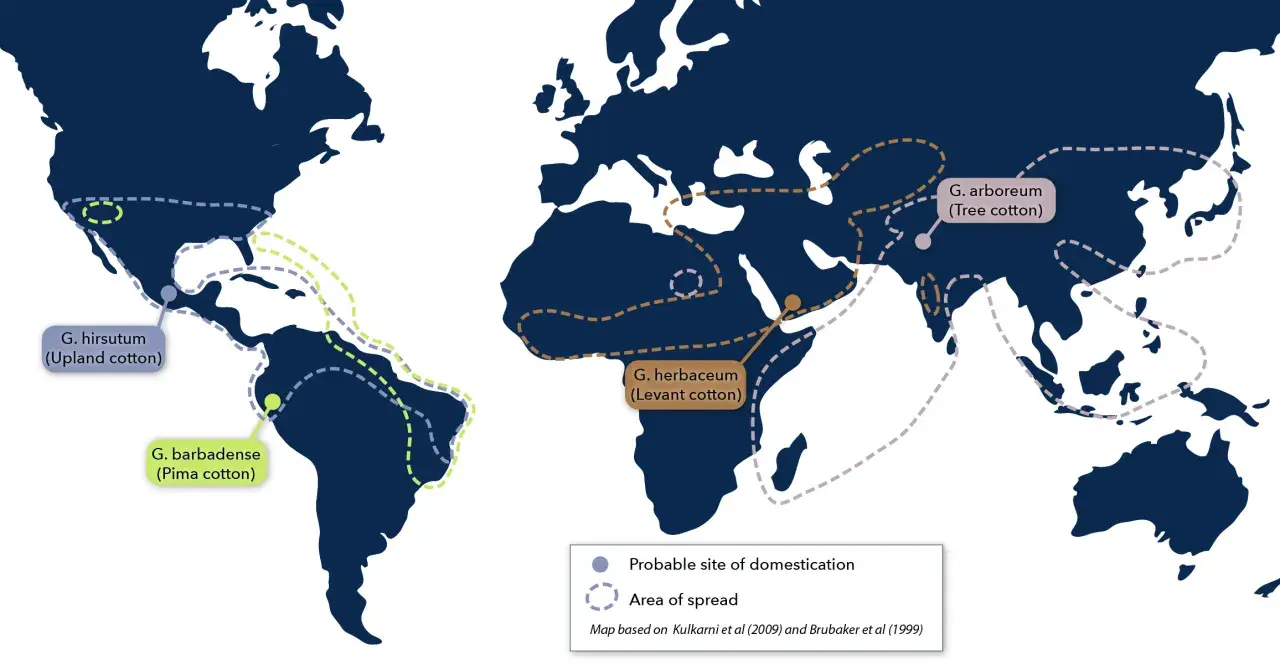
Cotton has a much more layered backstory than the fabric stack in a sewing room suggests. The answer to where is cotton native to is not a single country but several warm regions where different cotton species evolved, were domesticated, and eventually entered global trade. In this guide, I break down the native ranges, explain why they matter, and show what that history means when you choose cotton for sewing or buying fabric in the UK.
Key facts to remember about cotton’s native range
- Cotton has several native homes, not one birthplace.
- The main origin regions are the Americas, Africa, and South Asia.
- Different cotton species were domesticated separately, which is why cotton fabrics can vary so much.
- Native range is not the same as where cotton is grown, spun, woven, or sold today.
- For sewing, the best clues are still weight, weave, staple length, and finish.
The short answer is that cotton has several native homes
The cleanest answer is that cotton does not come from one origin point. Different species of the cotton genus developed in different warm regions, so the plant’s story is spread across continents rather than anchored to a single place. That is why a fabric shopper can read “cotton” on a label without learning anything about the plant’s geographic roots.
In practice, the most important native regions are the Americas, Africa, and South Asia. Those are the areas where the main cultivated cotton species emerged and were taken into human use thousands of years ago. I find that this matters because it separates two ideas that people often mix up: where cotton is native and where modern cotton fabric is produced. The next step is to look at the species behind that history.
The four cultivated cotton species tell the real origin story
When people talk about cotton’s origin, they are usually talking about four domesticated species of Gossypium. Each one has its own native range, and that spread explains why cotton is such a global textile fibre rather than a plant tied to one homeland.
| Cotton species | Native range | Why it matters for fabric |
|---|---|---|
| Gossypium hirsutum | Mexico to Ecuador and north-eastern Brazil | The main workhorse of modern cotton textiles; widely used for everyday clothing and household fabrics. |
| Gossypium barbadense | Colombia to Peru | Known for extra-long staple fibre, which is often prized for smoother, finer yarns and premium feel. |
| Gossypium arboreum | India and Sri Lanka | An older Asian cotton species, historically important and still valued in some regional textiles. |
| Gossypium herbaceum | Southern tropical Africa and parts of Southwest Asia, from Syria to Afghanistan | Another older domesticated cotton, associated more with historic and regional use than mass-market fashion fabric. |
This is the key point: the native range belongs to the plant species, not to the finished cloth. A bolt of cotton poplin in a UK shop may be made from fibre grown in one country, spun in another, woven elsewhere, and finished somewhere else entirely. Once you see that chain, the fabric label starts to make a lot more sense.
Why origin matters less than fibre length, weave, and finish
I would never choose cotton fabric by origin alone. In sewing, what usually changes the result is not the continent where the plant first evolved, but the fibre characteristics and the way the cloth is made. Staple length is the clearest example: it simply means the length of the cotton fibres, and longer fibres can usually be spun into smoother, stronger yarns.
That is why two fabrics can both be 100% cotton and still behave very differently. A crisp cotton poplin, a soft brushed cotton, a tightly woven percale, and a stretchy cotton jersey all start from cotton fibre, but their structure changes how they drape, breathe, crease, and wear. In sewing terms, I care just as much about weave or knit structure as I do about the fibre itself, because the construction determines whether the fabric is stable, fluid, warm, or structured.
For most projects, these are the factors that actually change performance:
- Fibre type affects softness and yarn quality.
- Staple length influences smoothness, strength, and pilling resistance.
- Weave or knit controls drape, stretch, and structure.
- Finish changes the hand, sheen, and wash behaviour.
That distinction becomes useful the moment you start comparing fabrics for a shirt, dress, quilt, or home project, which is exactly where UK buyers need the clearest guidance.
What cotton origin means when you buy fabric in the UK
In the UK, fabric labels usually tell you more about composition and finishing than about farming geography. A label that says “100% cotton” confirms the fibre content, but it does not tell you whether the fibre came from India, the United States, Peru, or somewhere else. For a sewer, that is normal. It is also why I look beyond the fibre name and read the full description before I buy.
Here is the practical way I read cotton labels:
| Label clue | What it tells you | What it does not tell you |
|---|---|---|
| 100% cotton | The fabric is made entirely from cotton fibre. | Where the cotton was grown or which species it came from. |
| Organic cotton | The cotton was produced under organic farming rules. | Whether the fabric is light, heavy, soft, crisp, or stretchy. |
| Egyptian cotton, Pima cotton, Supima | Usually a cotton type or market term associated with long-staple quality. | That every product with the name is identical in origin or construction. |
| Poplin, lawn, twill, jersey, flannel | The weave or knit, which affects how the fabric behaves. | The plant’s native range. |
For a British wardrobe or home project, I would usually prioritise weight, weave, and finish over birthplace. A midweight cotton works better for a shirt than a lightweight lawn; a brushed cotton makes more sense for cooler weather; a cotton jersey suits stretch garments. The origin story is interesting and useful, but it is not the final test of whether a fabric will work.
The myths that make cotton sound simpler than it is
A few persistent myths still blur the picture, and clearing them up helps you make better fabric choices. The first is that cotton has one native country. It does not. The second is that a famous regional name, such as “Egyptian cotton,” tells the whole story. It does not either; these labels usually point to a fibre type or market category, not the complete botanical history of the plant.
The third myth is that origin automatically predicts quality. I would push back on that. Quality in cotton fabric depends on several layers working together:
- the species and staple length
- the spinning method
- the weave or knit
- the finishing process
- the intended use of the cloth
So if you are choosing fabric for a project, the better question is not simply where cotton began on the map. It is how that cotton was turned into cloth, and whether that cloth suits your pattern, your climate, and the finish you want.
What I would check before choosing a cotton fabric
When I am choosing cotton for a project, I use a simple order of priorities. First, I match the fabric to the garment or item. Second, I check the weight and drape. Third, I look at the finish and care instructions. The geographic origin is still interesting, but it sits behind those practical decisions.
- For shirts and blouses, I look for cotton lawn, poplin, or fine shirting.
- For dresses, I consider cotton voile, lawn, or a medium-weight cotton with enough drape.
- For trousers or structured pieces, twill, drill, or canvas usually behaves better.
- For casual tops and knit garments, cotton jersey is the obvious starting point.
- For quilts and home sewing, stable woven cottons are usually the safest choice.
So the practical answer is this: cotton is native to several warm regions, especially across the Americas, Africa, and South Asia, but the better sewing question is how that cotton was grown, processed, and woven into fabric. If you keep that distinction in mind, cotton becomes much easier to read, buy, and use well.