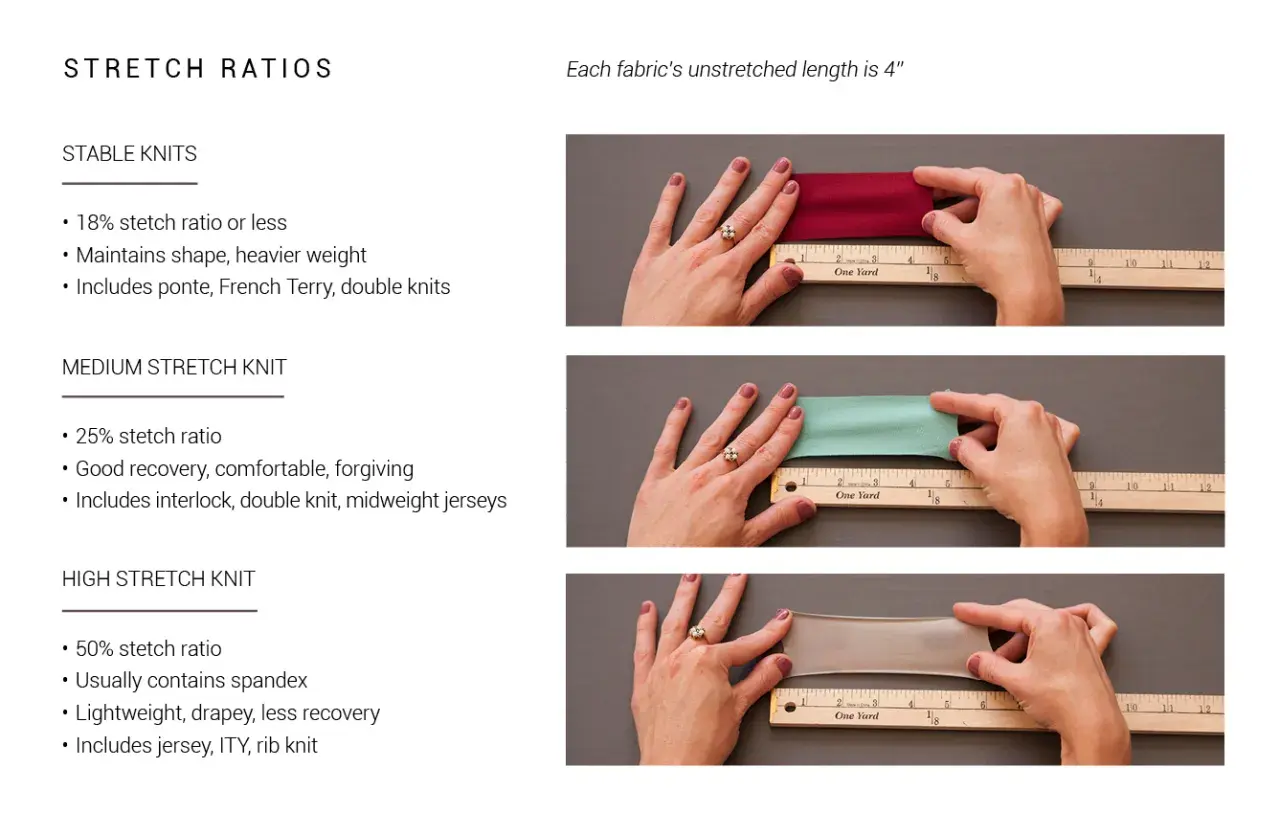
Stable knits are the fabrics I reach for when I want comfort without losing shape. They have enough give to move with the body, but enough body to keep seams neat, hems flatter, and collars from waving about. This guide explains what makes a knit stable, which fabrics belong in that group, how they compare with more elastic knits, and how I sew them so they stay clean and reliable.
The essentials at a glance
- Stable knits have limited stretch and strong recovery, so they hold their shape better than jersey.
- Common examples include ponte di Roma, interlock, double knit, and some sweatshirting.
- They are easier to cut and sew because they curl less and shift less under the machine.
- They suit structured tops, dresses, skirts, trousers, and light jackets more than very close-fitting activewear.
- Stretch direction matters: most stable knits give more across the width than down the length.
- A swatch test tells you more than the fabric name on the bolt.
What makes a knit fabric stable
Stability is about behaviour, not zero stretch. A stable knit still moves, but it does not keep growing when you pull it, and it usually snaps back into shape quickly. In practical terms, I look for limited horizontal stretch, very little vertical stretch, and a fabric that does not sag, bag out, or curl aggressively at the cut edge.
Construction matters as much as fibre content. Double knits, interlocks, and dense ponte structures feel steadier because the loops are more controlled and the fabric has more body. A small amount of elastane can improve comfort without making the fabric unstable, but recovery has to stay crisp. If the cloth stretches and then stays stretched, it is no longer behaving like a stable knit in any useful sewing sense.
That difference is why one knit feels easy and neat on the table while another turns into a wavy neckline or a hem that slowly sinks out of shape. Once that is clear, the next step is recognising the fabrics where stability shows up most clearly.
The stable knit types you are most likely to buy
In UK fabric shops, the stable knits I see most often sit in a fairly small family of fabrics. The names vary a little from retailer to retailer, but the behaviour is usually easy to spot once you know what to feel for.
| Fabric type | How it feels | Typical behaviour | Best for |
|---|---|---|---|
| Ponte di Roma | Firm, smooth, medium to heavy weight | Very stable, little curling, good recovery | Dresses, skirts, trousers, structured tops, light jackets |
| Interlock | Soft, smooth on both sides, usually medium weight | Stable with modest stretch and a flatter finish | T-shirts, children’s clothes, pyjamas, relaxed tops |
| Double knit | Substantial, often reversible, with good body | Holds shape well and usually curls less than a single knit | Skirts, trousers, cardigans, tailored knit pieces |
| Sweatshirting | Cosy, heavier, sometimes brushed on the inside | More body than jersey, but stability varies by blend and finish | Sweatshirts, joggers, casual dresses, overshirts |
I treat those categories as starting points rather than fixed rules. A ponte can be firmer or softer depending on fibre mix, and a sweatshirt knit can be surprisingly stable or a little too stretchy for a neat neckline. That is why I always test the cloth itself instead of trusting the label alone. From there, it helps to compare stable knits with the fabrics people most often confuse them with.
How stable knits differ from jersey, rib, and high-stretch knits
One of the easiest ways to understand stable knits is to place them next to the fabrics that sit just outside the category. The differences are small in theory and very obvious in use.
| Fabric type | Stretch level | Recovery | What it means in sewing |
|---|---|---|---|
| Stable knit | Low to moderate | Usually good | Easier to handle, less curl, more structure |
| Jersey | Moderate to high | Depends on blend | More drape, more curl, better for fluid tops and dresses |
| Rib knit | High widthwise stretch | Usually strong | Great for cuffs and neckbands, less predictable as a main garment fabric |
| High-stretch activewear knit | Very high | Usually excellent | Built for close fit and movement, not for structure |
Jersey is the comparison I make most often because it is where people get tripped up. A jersey can look similar on the rail, but it usually has more curl and less body, so it behaves differently under a pattern that needs structure. Rib knits are another common misunderstanding: they can be wonderfully springy, but that stretch is precisely why they are best used in bands and fitted details rather than as the main fabric for a tailored garment.
If a pattern asks for a high stretch percentage or depends on negative ease, a stable knit may be too firm even if it feels soft in your hand. That brings us to the question that matters most in practice: what should you actually make with it?
Where a stable knit works best in dressmaking
I reach for stable knits when I want a garment to skim the body rather than cling to it. They are especially useful when the pattern has clean seams, shaping, or details that need to stay crisp after wearing and washing.
- Structured dresses work well because the fabric supports hems, darts, and seam lines without collapsing.
- Skirts, especially pencil or A-line shapes, benefit from the extra body and smoother drape.
- Relaxed trousers and joggers are comfortable in stable knits because the fabric has enough substance to avoid bagging at the knees.
- Top layers such as cardigans and light jackets gain shape from ponte and similar fabrics without feeling stiff.
- Children’s clothes and everyday basics are easier to sew and usually last better when the knit is stable enough to hold up to frequent wear.
I would not choose a stable knit for leggings, swimwear, or very close-fitting sportswear. Those garments need more stretch and more recovery than this category usually offers. If the pattern relies on the fabric stretching a long way to get on and off, a stable knit will fight the design rather than support it. Once you match the fabric to the garment, the sewing becomes much more predictable.
How I sew stable knits without distorting them
Stable knits are friendlier than slippery jersey, but they still deserve a careful setup. I keep the approach simple and consistent because the small habits matter more than dramatic machine settings.
- Prewash the fabric if the fibre content can shrink, especially cotton and viscose blends.
- Use a stretch needle or ballpoint needle, usually 75/11 or 80/12 for most dressmaking weights.
- Let the feed dogs do the work; do not pull the fabric from the front or back as you sew.
- Choose the stitch for the seam’s job: a narrow zigzag or stretch stitch for seams that need movement, and a straight stitch only where the seam will not be forced to stretch.
- Lower presser foot pressure if your machine allows it, especially on softer stable knits that want to wave.
- Press, do not drag; a hot iron and too much movement can distort the edge faster than the machine will.
- Stabilise shoulder seams if needed with stay tape or clear elastic when the garment carries weight in that area.
One detail I keep coming back to is stitch length. On firmer stable knits, a slightly longer stitch often gives a cleaner line and reduces the risk of perforating the fabric. I usually test between 2.5 mm and 3 mm on a scrap before I touch the real garment. That small trial saves more seam-ripping than any advanced trick ever will, which is why the next check I make is always the fabric itself.
The quick checks I make before I cut a stable knit
Before I cut into a stable knit, I want proof that it will behave the way the pattern needs. A few simple checks tell me most of what I need to know.
- Test the stretch across 10 cm: if it only grows by a small amount, usually around 1 to 3 cm, you are in stable territory rather than high-stretch territory.
- Check the recovery: stretch it, release it, and see whether it returns quickly without looking tired or rippled.
- Look at the cut edge: heavy curling usually means more handling time and less precision.
- Hold it up to the light: if it is sheer, plan for lining, underlining, or a different garment shape.
- Read the pattern requirements carefully: a stable knit works best where the pattern allows ease and does not depend on strong stretch.
- Feel the weight in your hand: if it has too much drape for the shape you want, the finished garment will probably follow that drape whether you want it to or not.
The fabrics that feel most manageable are not always the best choice, and the fabrics with the prettiest drape are not always the easiest to sew. A stable knit rewards a pattern that respects its limits: give it room where it needs room, structure where it needs support, and a gentle hand at the machine. That is usually enough to turn a good fabric choice into a garment you will actually wear.