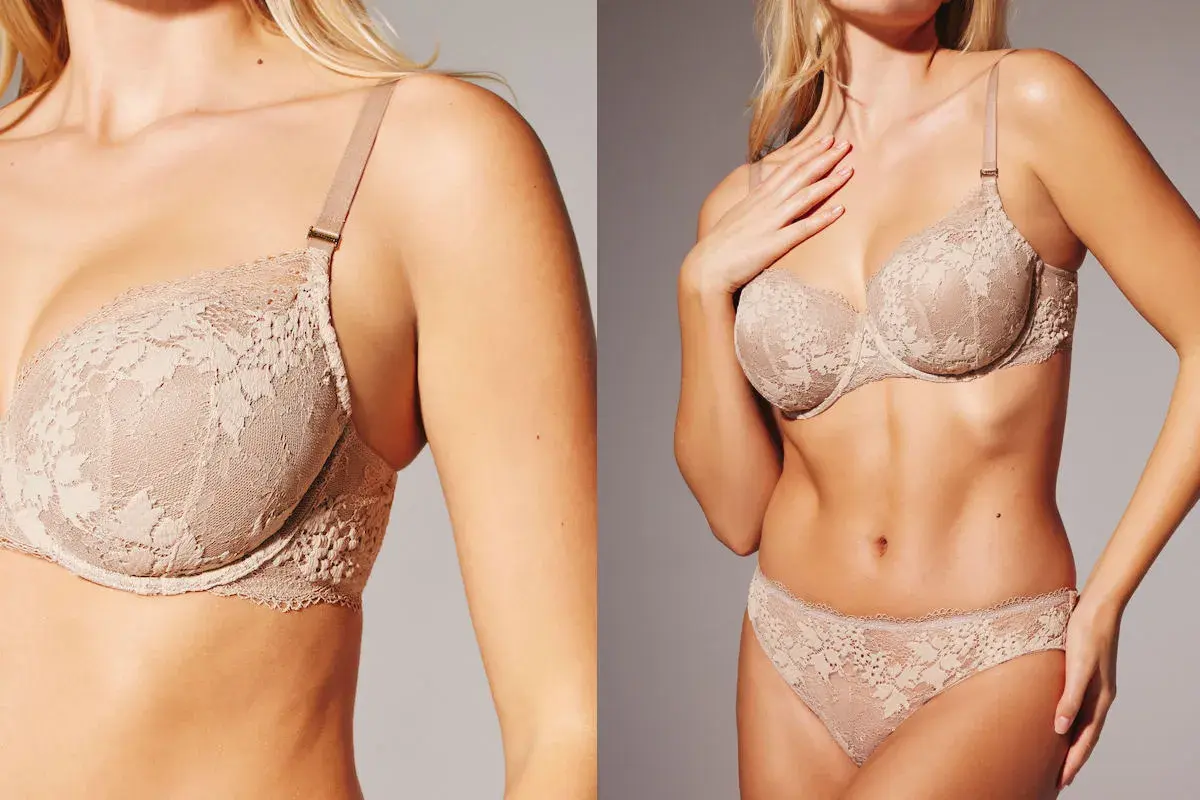
A balconette bra pattern works best when the shape, wire, and fabric all support the same goal: lift from below, a lower neckline, and a clean upper edge that still feels secure. In this article, I break down what makes that style different, how to choose the right size and wire, which materials actually matter, and how to fit the first sample without wasting your best lace.
What you need to know before you cut the fabric
- A balconette-style bra usually gives half to three-quarter cup coverage, with a neckline that sits lower than a full-cup bra.
- The bridge, cradle, and wire size matter as much as the cup size. If those are off, the bra will not behave well.
- Stable cup fabric and firm band fabric make the biggest difference to support and shape.
- A test bra is worth making, even if the final version is meant to be pretty.
- Small fitting changes, usually around 1/4 in or 6 mm at a time, are safer than big edits.
- Most of the real success comes from matching the pattern to your body shape, not from decorative fabric alone.
What a balconette bra actually changes in fit and shape
When I look at this style, I think of it as a support-first bra with a deliberately open neckline. The cups usually sit lower across the bust than a full-cup style, but they still rely on structure: a cradle, a firm band, and usually underwires. That combination gives the lifted, rounded shape people want without pulling the neckline up too high.
What makes it useful for dressmaking is the balance it creates. The cup design often brings breast tissue upward and slightly inward, while the strap placement stays wide enough to support the side of the cup without dominating the front. It is a good match for outfits with lower necklines, square necks, or wrap shapes where a higher bra would show too much.
I would not treat it as a universal solution, though. If you want maximum coverage, a full-cup draft will be easier to live with. If you want a very soft or lounge-like fit, a wireless bralette may suit you better. A balconette lives in the middle: more shaped and anchored than a bralette, but less covering than a full-cup everyday bra. That distinction matters before you even open the pattern pieces, because it tells you what kind of fit to expect next.
Getting the size, wire, and bridge right before cutting
The biggest mistake I see is choosing a cup size first and treating everything else as secondary. For this kind of bra, the band, bridge, and wire line are not background details. They are the frame the cups sit on. If that frame is wrong, the cups can be technically “correct” and still fit badly.
Start with the pattern company’s size chart, but check whether the drafting uses UK cup lettering, since many lingerie patterns do. In many UK-drafted systems, the cup sequence moves through A, B, C, D, DD, E, F, FF, G, GG, H. That is useful to know because it can look different from other size systems even when the actual volume is similar.
Then look at three things together:
- The band should sit level and firm on the body without riding up.
- The bridge is the centre front piece between the cups; it should sit close without being forced apart.
- The wire should follow the base of the breast without sitting on tissue or floating too far away.
When I test a new frame, I like to treat the wire as a separate decision, not something the cup size magically solves. The wrong wire width can make a good cup feel wrong, and the wrong band tension can make the bridge behave as though the cups are too small when they are not. If you need to fine-tune, I would keep changes small: no more than 1/4 in, or 6 mm, in one area before I rethink the overall size or wire shape. That keeps the draft controlled instead of turning it into a guessing game.
| Fit point | What you want | What goes wrong when it is off |
|---|---|---|
| Band | Snug and level around the body | Rides up, spins, or fails to anchor the cups |
| Bridge | Close to the sternum without digging | Pops away, collapses, or pinches |
| Wire line | Sits around the breast root | Presses into tissue or sits too far out |
| Cup volume | Supports without wrinkles or spillover | Gaping, flattening, or overflow at the top |
Once those three are working together, the rest of the pattern becomes much easier to judge, because you are fitting a system rather than isolated pieces.
Fabrics and notions that make the pattern behave
A balconette bra lives or dies by its materials. Decorative lace can be beautiful, but it rarely carries the whole garment on its own. I think of the fabric stack in layers: one layer creates shape, another controls stretch, and another protects the body from hard edges or wire pressure.
For the cups, choose a stable fabric with limited stretch. That might be duplex, simplex, stable lingerie lace with a firm lining, or a similar fabric the pattern is drafted for. If the lace is soft and open, line it. If the cup is lightly foamed, make sure the pattern allows for that thickness rather than forcing it in later. For the back band, power mesh or another firm stretch support fabric usually gives better anchoring than a decorative stretch knit.
| Component | What it does | What to look for |
|---|---|---|
| Cup fabric | Defines the shape of the breast | Low-stretch, stable, and consistent in both cup pieces |
| Lining | Stops collapse and supports lace | Light but firm enough to hold the cup curve |
| Band fabric | Anchors the entire bra | Strong stretch support with recovery |
| Channeling | Holds the underwire | Firm, smooth, and comfortable against the skin |
| Elastic | Controls the edge and helps fit | Use the type the pattern calls for, not random craft elastic |
| Closures and straps | Finish support and adjustability | Hardware that matches the band width and strap weight |
I would also resist the temptation to “fix” a weak fabric choice with extra elastic everywhere. That usually makes the bra feel tighter without making it better. A better lining, a stronger band, or a more suitable cup fabric will usually solve the problem more cleanly. Once the material plan is sensible, the sewing steps themselves become much less frustrating.
How I sew the first version without wasting good fabric
For a first sample, I want information, not perfection. A bra muslin is there to show me what the frame is doing, how the cup behaves, and whether the pattern and my body shape agree. I do not need pretty stitching for that. I need a version I can mark, unpick, and learn from.
- Cut the sample in similar-weight materials to the final bra, especially for the cup and band.
- Baste the cup seams first so I can check the shape before committing to finishing stitches.
- Assemble the cradle, bridge, and wires early enough to test the frame before adding all the decorative elastic.
- Try the bra on and check the band, bridge, and neckline before trimming anything too aggressively.
- Only after the shape looks right, finish the elastic, straps, and closure cleanly.
The most useful word here is muslin, which in lingerie sewing just means a test version. It does not have to be ugly forever, but it should be easy to mark and alter. I often leave the channeling ends open, use a long stitch, and keep the finishing loose enough to adjust. That sounds untidy, but it saves time because I can see the fit problems before the pretty fabric comes into play.
One practical habit helps more than anything else: trace the seam lines, not just the cut lines, and walk the pattern pieces against each other before sewing. That catches mismatch early. If the cup seam no longer meets the cradle cleanly after a change, I stop and redraw it instead of pretending it will sort itself out later.
The fitting fixes that usually save the result
Most fitting problems in this style can be diagnosed from a few visible signs. I find it easiest to work from the symptom backwards. Is the bridge floating because the cups are too small, or because the band is too soft? Is the neckline gaping because there is too much volume, or because the top edge is cut for a different breast shape? The answer changes the fix.
| What you see | Likely cause | What I would change first |
|---|---|---|
| Bridge lifts away from the body | Cups too shallow, wire too light, or band too weak | Check cup volume first, then wire strength and band stability |
| Top edge gapes | Too much cup volume at the neckline or a shape mismatch | Remove a small amount of neckline volume or choose a different cup shape |
| Overflow at the top or side | Cup too small or neckline too low for the breast shape | Increase cup volume before changing the lace or trim |
| Wrinkles in the cup | Cup too large or the breast is not filling the pattern shape | Reduce volume or switch to a different cup curve |
| Band rides up | Band too loose or back too stretchy | Firm up the band before altering the cups again |
The bridge is worth special attention. If it refuses to sit flat, people often blame the cup first. Sometimes that is correct, but not always. A soft band or underwire that is too delicate can leave the front with nowhere to anchor. In other words, the cup may not be the only problem. I also pay attention to the upper cup and lower cup relationship: if the seam line sits visibly above the fullest point of the breast, the fit can look technically neat while still feeling off.
When in doubt, I make one adjustment at a time. A lot of bra fitting goes wrong because sewists alter three things at once, then cannot tell which change helped. If you keep each correction small, the pattern teaches you quickly. That is especially important with a balconette shape, because a small change in cup height or wire width can change the whole silhouette.
How it compares with other bra styles
Choosing this style makes more sense when you compare it with the alternatives. The real question is not whether a balconette is “better”. It is whether it fits the kind of garment you want to wear, the support you need, and the amount of coverage you are comfortable with.
| Style | Coverage | Support feel | Best use |
|---|---|---|---|
| Balconette | Low to medium | Structured, lifted, and open at the neckline | Lower necklines and a rounded, framed shape |
| Full-cup bra | High | Very secure and enclosing | Everyday wear when coverage and containment matter most |
| Plunge bra | Low at centre front | Can be supportive, but shape is more focused on the centre | Deep necklines and front opening without much visible cup |
| Bralette | Low | Light, soft, and less structured | Comfort, lounging, and low-support days |
If I were helping someone choose between them, I would usually say this: pick a full-cup style if you want coverage and containment; pick a plunge if the neckline is the main priority; pick a bralette if comfort is the brief; choose a balconette when you want support but do not want the bra to dominate the neckline. That is why this style is so popular for sewing. It has a clear design purpose, and the result is obvious when the pattern is right.
The details I would carry into the next sample
After the first version, I do not rush into a new fabric choice. I carry forward the facts I already learned: which wire shape felt right, where the bridge sat, how much tension the band needed, and whether the upper cup needed more or less height. That record is more valuable than a pile of random tweaks.
- Keep notes on the exact wire size, band length, and cup size that were closest to right.
- Save a marked copy of the seam lines so you do not repeat the same fitting mistake.
- Change the fabric only after the frame fits, not before.
- If the bra looks elegant but feels unstable, strengthen the lining or band instead of chasing decoration.
- Once the shape works, repeat it with a better lace or a more refined finish.
A good balconette bra pattern is less about chasing a dramatic neckline and more about getting the cradle, cup volume, and band strength to cooperate. When those three pieces are right, the style becomes surprisingly wearable, and the sewing itself gets more enjoyable because each sample has a clear job. If you treat the first version as a fitting tool, not a final verdict, you end up with a bra that looks polished and behaves the way the pattern promised.